
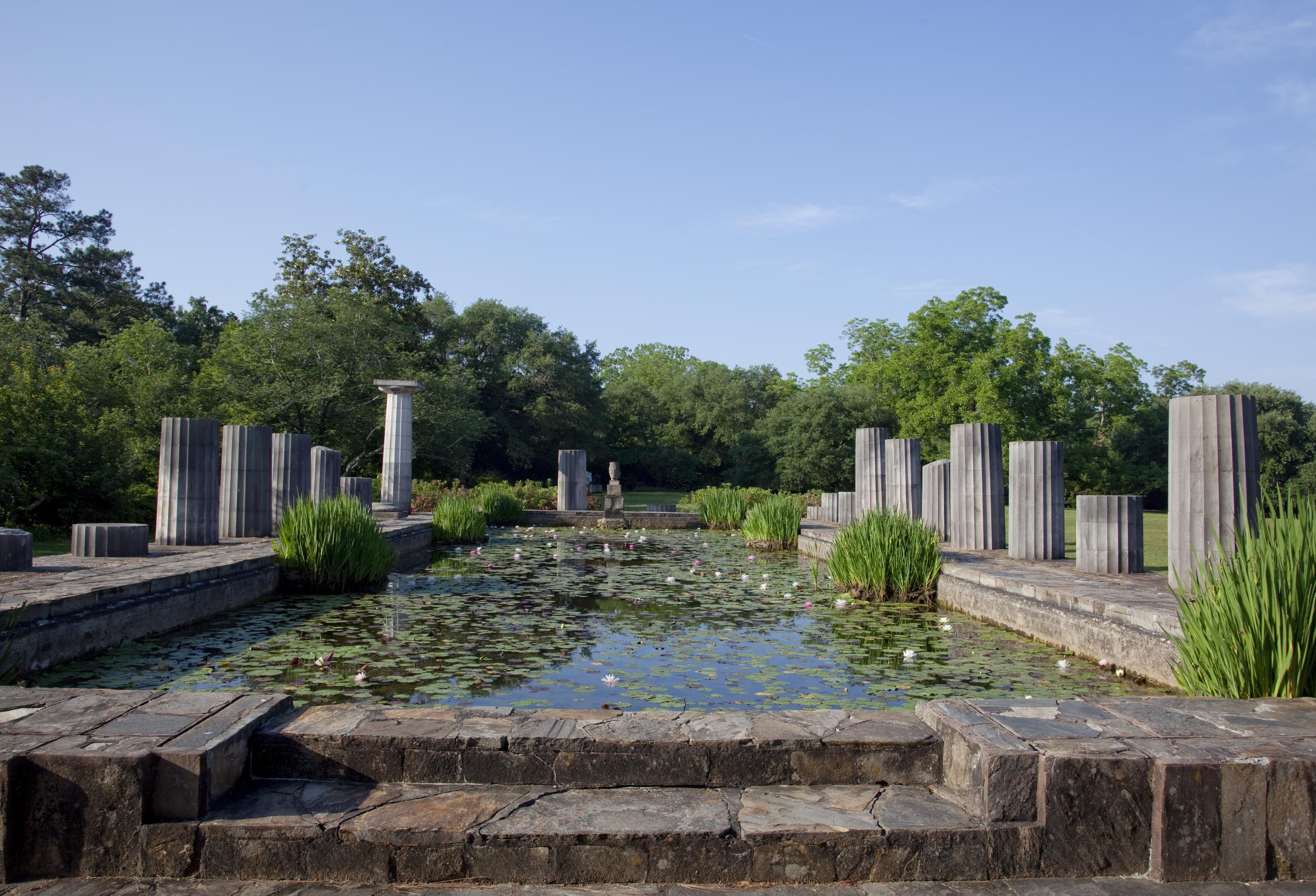
Credit: The George F. Landegger Collection of Alabama Photographs, Carol M. Highsmith photographer, Library of Congress Prints and Photographs Division.
A highlight of the 1986 annual meeting in Montgomery was a Saturday afternoon visit to Jasmine Hill Gardens in Wetumpka, Alabama.* Sadly, two of our charter member hosts, Ed Givhan and George Stritikus, are no longer with us, both having died in 2004.** They thus did not survive to see Jasmine Hill Gardens close permanently in 2020.** Since we are a history society, however, it seems all the more important that we recall Ed Givhan and George Stritikus and record such an important garden as Jasmine Hill Gardens to help keep their memory alive.***
Like every garden creator and every garden, Jasmine Hill Gardens was a unique spot on earth. Here, that special individual character arose from a couple’s love of all things relating to Ancient Greece. The people in question were Alabama natives Benjamin and Mary Mapes Fitzpatrick, the pair having sold a chain of stores a few years prior to the onset of the Great Depression and retired comfortably while still in their forties to a property in Wetumpka.
The Fitzpatricks had no intention to simply rest and relax for the remainder of their days, however, but instead they focused on creating a unique place that would mimic in the hills of Alabama a setting drawn from the Hellenic world. Perhaps an initial visit sparked their interest in Greek culture, art, and architecture, but whatever the impetus it was nourished and honed by numerous trips to Greece along with time spent studying at the American School of Classical Studies in Athens.
A desire to enjoy their passion in ways beyond books, small sculptures, and images on the wall may have led the Fitzpatricks to set up Jasmine Hill Gardens, a twenty-acre site that would be populated by a wide array of full-scale reproductions of famous statues acquired from Greece and Italy. Taking its name from the abundance of star jasmine in the area, the new garden would consist of a series of rooms centered on marble copies of such famed sculpted deities as Athena, Venus, and Nike (aka Winged Victory), along with a bust of Homer and a recreation of the well-known Hellenistic-period statue The Dying Gaul. Sources indicate that Mary Fitzpatrick largely took the lead in laying out these spaces to include walls, water features, pathways, and materials for plantings.
Standing out most prominently was a reconstruction of the Temple of Hera at Olympia, a Greek archaeological site visited by the Fitzpatricks. So impressed was the couple that they commissioned detailed drawings for use on their return home. Thus, as built it closely followed the size and appearance of the original including foundations, Doric columns and column remnants, and interior flooring components. Making it distinct, however, was the installation of a rectilinear pool and aquatic plants that added an interesting dimension not present in the actual Greek example.
The Hera Temple figures large among 1986 memories, as do recollections of the supper enjoyed at the JHG restaurant. By that time, however, famed supporters of the arts Jim and Elmore Inscoe had acquired Jasmine Hill Gardens, the widowed Mary Fitzpatrick having died in 1982. The Inscoes, in turn, would form a foundation to assume management of day-to-day operations and fundraising at Jasmine Hill Gardens.
For almost forty years that nonprofit organization not only kept Jasmine Hill Gardens functioning as the Fitzpatricks would have wished but also enhanced the site in various ways and expanded programing ventures to include such activities as major musical events. Someone involved on the site improvement side was Ed Givhan, the 1986 meeting organizer mentioned previously and also a past president of the Society. Just prior to the Montgomery gathering, for example, the Winter 1985 issue of Magnolia noted about Jasmine Hill Gardens that “until recently plant materials consisted of trees and shrubs only, but Dr. Givhan and others are now planting flower borders to expand the interest and bloom period in the garden.”
In the end, expanding the array of ornamental plants and their bloom period would be insufficient to ward away the impact of a global pandemic. In spring 2020, the Jasmine Hill Gardens and Outdoor Museum governing body announced the permanent closure of the site for visitation. Surely, however, it will have a firm place in the memories of visitors from across Alabama, the nation, and the world, just as in 1986 Jasmine Hills was logged into our Society’s pantheon of remarkable landscapes.
***************************************************************
*For a review of the meeting by Magnolia editor Harriet Jansma, see: https://southerngardenhistory.org/wp-content/uploads/V-.-2-no-.-4-Spring-1986.pdf#page=9.
**For a detailed discussion of Jasmine Hill Gardens and its founders, see: https://encyclopediaofalabama.org/article/jasmine-hill-gardens/
***Another meeting host, Judge Peggy Givhan, remains active in the Montgomery garden world and writes a regular column for The Alabama Gazette.
***For a filmed visit, scroll to “-7:50/10:19”minutes of the following Simply Southern program: https://www.youtube.com/watch?v=y8NRG3Coa7s
Leave a Reply