Credit: Mx. Granger, Wikimedia Commons
Our September 11, 2026, Gardens post featured an 1850s A. J. Davis grounds plan showing a botanical garden within the overall UNC site. Yet, nothing of the sort seems to have been present until the mid-campus Coker Arboretum took shape in the early twentieth-century. Development of a large-scale botanical garden began only in the 1950s, however, at a setting on the outskirts of campus that had sufficient land to realize its founders’ vision.
It was here during the late 1970s-early 1980s that several meetings between Flora Ann Bynum, John B. Flowers III, and William Lanier Hunt led to the 1982 creation of the Southern Garden History Society. As discussed below, Hunt had many ties to the North Carolina Botanical Garden, including a donation of over a hundred acres along Morgan Creek, an area today known as the William Lanier Hunt Arboretum. Clearly this is a special place for the Society.
In 1952, the founder of the arboretum bearing his name, William Chambers Coker, spearheaded the creation of the first seventy acres of NCBG. In addition, Coker was ably assisted by his student and life-long UNC natural sciences professor Henry Roland Totten.* Yet another person linked to early times there was C. Ritchie Bell, a UNC botany instructor-researcher who in 1961 became the Botanical Garden’s first director. Under Bell’s guidance, five years later NCBG would open a public pathway, welcoming visitors with the words: “You are invited to walk the trail at different seasons, to enjoy the changing variety of nature, to observe the development of the Garden, and to suggest appropriate ways in which the Garden may better serve its purposes of conservation, education, and research.”**
NCBG would soon became known for its “Conservation through Propagation” ethic, decrying collecting plants from the wild unless forced by looming habitat destruction. Instead, NCBC embraced and promoted standards that encouraged propagation through cuttings or seeds, while staff developed public awareness programs stressing the need to protect native plants in situ. Here again Bill Hunt’s name comes to the front for having influenced NCBG director Bell through such writings as Hunt’s ca. 1968 essay “Grow the Wild Flowers, Cultivation is Conservation,” and doubtlessly via his own notable powers of persuasion.***
Hunt’s involvement took other forms as well. Beyond his major land donation and providing NCBG with philosophical underpinnings, he also took the lead in gathering financial support. For example, a June 5, 1966, article in the Durham Morning Herald announced the creation of a North Carolina Botanical Garden Foundation with Bill Hunt serving as president. Several years later, the November 17, 1968, Morning Herald included a photograph of Hunt presenting Botanical Garden director Bell with a check for $1,500, an amount that in 2026 would equal almost $15,000. The article also noted that NCBG, then totaling 329 acres, encompassed a variety of habitats that would allow “a nearly complete collection of the native plants of the Southeastern states.”
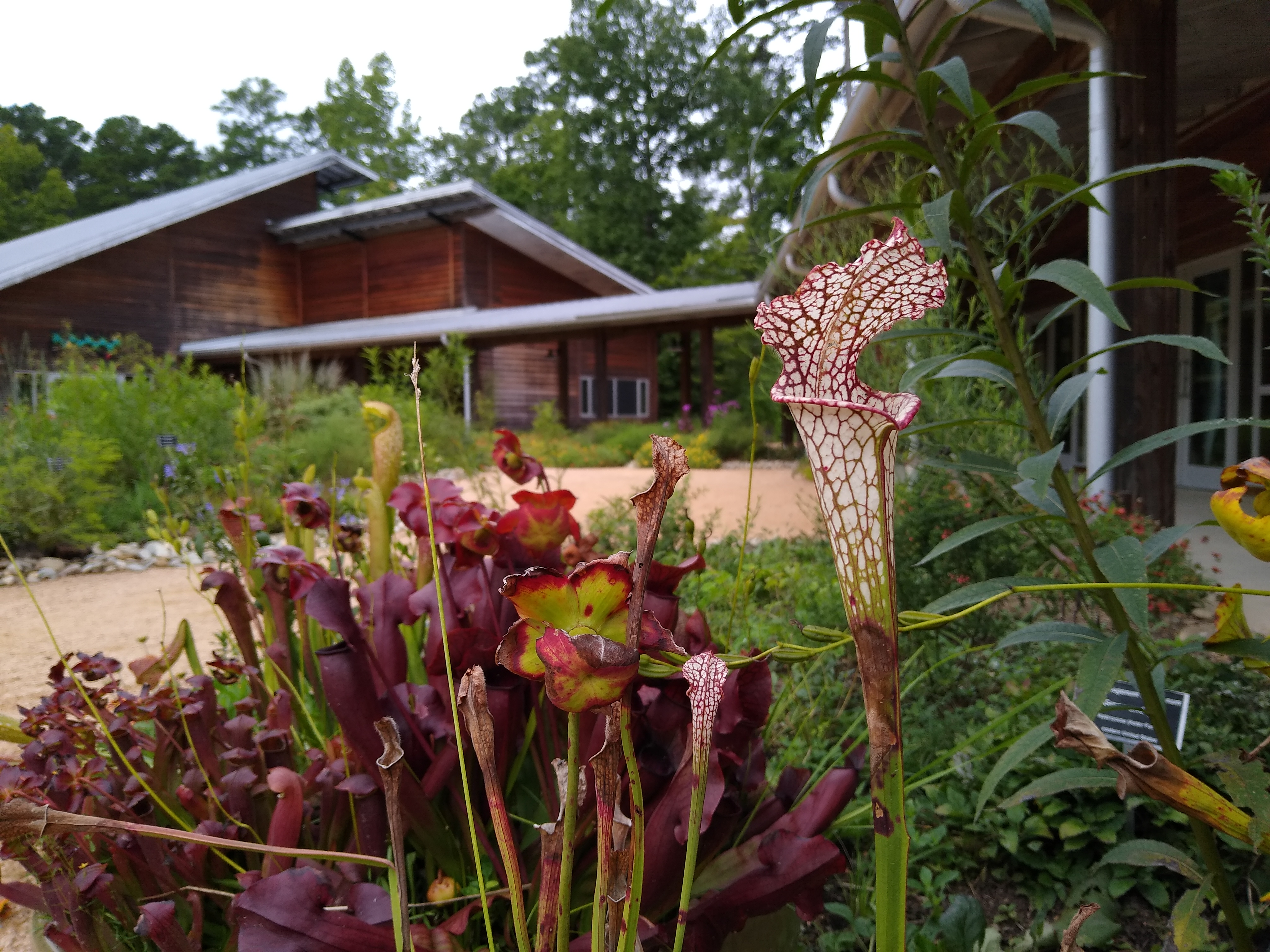
Today NCBG manages over twice the land it did in 1968, and visitors can tour gardens displaying the flora of four of the Tarheel state’s regions: mountains, piedmont, sandhills, and coastal plain. As well, a focus on conservation is joined by an interest in sustainability, this being evidenced by NCBG’s environmentally-friendly buildings that feature geothermal climate control, solar power, and rain-collecting capabilities that provide staff with a substantial percentage of the gardens’ water needs.
As noted in the September 11 post, this author hopes our 2028 North Carolina meeting itinerary will allow members to explore a bit of NCBG’s seven-hundred-plus acres. We can then offer a double tip of the hat to Bill Hunt, who not only helped to make the NCBG what it is today but whose proposal at the 1979 Restoring Southern Gardens and Landscapes conference for a garden history society for the South also made us what we are today.
******************************************************
* https://ncbg.unc.edu/2021/05/11/henry-roland-totten/
** https://ncbg.unc.edu/about/mission-history/
***See A Conservation Garden: The North Carolina Botanical Garden at 50, p. 8:
https://ncbg.unc.edu/wp-content/uploads/sites/963/2019/04/NCBG50_Volume_I-1.pdf
For an entertaining look at NCBG, see:

Leave a Reply