
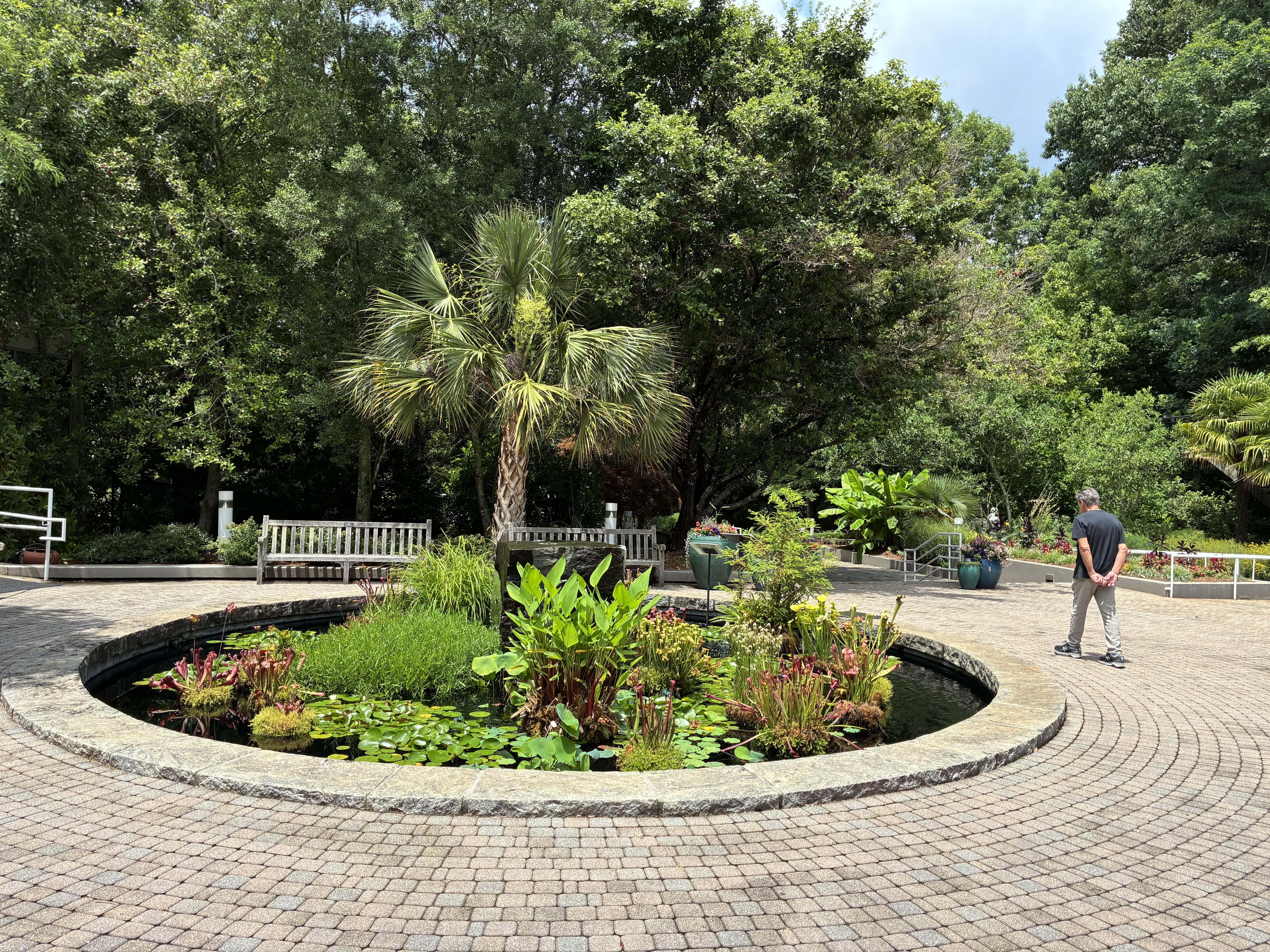
Credit: Gail Collmann Griffin
Members attending the 2024 Wilmington annual meeting had the pleasure of seeing long-time member, honorary director, and stalwart former chair of the scholarship and awards committee Dr. A. Jefferson Lewis III receive the Society’s foremost recognition, the Flora Ann Bynum medal. While Jeff Lewis has undertaken many tasks on behalf of SGHS, he is widely recognized professionally as director of the State Botanical Garden of Georgia (SBGG)* between 1989 and 2009. Jeff, who began teaching at the University of Georgia (UGA) in 1983, is now director emeritus of SBGG and professor emeritus of horticulture at UGA. He is also applauded for his writings, including Historic, Heritage & Heirloom Plants of Georgia and the American South published in 2004.
Society members were Jeff Lewis’s guests on April 11 during the 2008 Athens annual meeting, Jeff helping us to discover a collection of individual gardens under the SBGG umbrella. While the botanical garden dates only to late 1960s-early 1970s, it is not an idea new to Athens. A quick look at UGA’s history shows that the Athens campus had its first botanical garden only a few decades following the school’s founding. A historic marker at the intersection of Reese and Pope Streets notes that the university’s professor of natural history, Dr. Malthus Ward, had established a four-acre botanical garden there in 1833.** This, in turn, reflected a broader international interest in expanding the basic range of studies beyond a Latin, Greek, and mathematics core curriculum to include a range of classes in the sciences. Unfortunately, however, budget cuts forced it to close in 1856.
Over a century thus passed before the establishment of the SBGG we toured in 2008. As might be imagined, however, its new location had previously witnessed significant agricultural and industrial activity consistent with its Middle Oconee River location. For decades the land was part of a larger tract owned by the White family, known for their cotton milling activities centered in a mill and mill village site east of SBGG. As well, the Athens neighborhood of Whitehall takes its name from the area’s association with the Whites and their enterprises.
Vastly more expansive than its antebellum predecessor, the new botanical garden is set on 323 acres. Moreover, it has now operated well beyond the lifespan of Dr. Ward’s pre-Civil War garden. Its purpose has expanded as well. The heavily-visited SBGG offers its resources not just to UGA students but also to researchers from other institutions, to citizens of Athens, and other visitors from across the state and region. An aerial view underscores the fact that SBGG consists of nearly 90% wooded natural spaces accessible via a network of trails chiefly named for various tree species such as the Red Oak and Black Gum Loops. Contained within the smaller more extensively landscaped areas encircling the visitor center can be found gardens to match the interests of naturalists and garden fanciers of almost any stripe.
Still under development during our 2008 visit, the SBGG Flower Garden infuses the senses with the many changing forms and colors of a wide array of annuals and perennials. For those keen on Georgia’s past, the neighboring Heritage Garden offers a special pull. Here, as noted in the 2008 annual meeting review, can be found “plants significant to the state’s economic and cultural history,” ranging from peanuts, tobacco, cotton, and fruit trees, to antique roses and other ornamentals popular with our forebears.*** In turn, the International Garden presents a historical overview through structures and plants that span many centuries, commencing with medieval physic gardens and moving along to discuss the famed father and son plant explorers John and William Bartram and one of their best-known discoveries, Franklinia alatamaha. In addition, the large Alice H. Richards Children’s Garden reflects another designed landscape concept of great popularity.
Yet, there is even more to explore and learn at SBGG. Here too, is a notable collection of tropical and other tender plants gathered in the conservatory of the 10,000 square foot Alice Hand Callaway Visitor Center and Conservatory. And while glass structures are not uncommon at such sites, no other botanical garden offers anything comparable to the SBGG Porcelain and Decorative Arts Museum.****
Lastly, SBGG is now widely recognized for its role in plant conservation. Apropos of the greatly expanding interest in native plants, it not only includes a Native Flora Garden, but it also serves as headquarters of the highly-regarded Georgia Plant Conservation Alliance, an organization whose efforts span Georgia and the wider region.*****
In sum, SBGG is a model of its kind as well as a site substantially improved since our 2008 tour. Thus, it is all the more satisfying to know that Jeff Lewis, a bedrock member of our Society, was long at the helm guiding SBGG through important periods of expansion and improvement.
*********************************************************
*To get a basic understanding of SBGG, visit: https://botgarden.uga.edu/
**https://www.georgiahistory.com/ghmi_marker_updated/university-of-georgia-botanical-garden-1833-1856/
***See Staci Catron’s meeting review in the Summer-Fall 2008 issue of Magnolia:
https://southerngardenhistory.org/wp-content/uploads/2015/12/Magnolia_summerfall_2008.pdf#page=8
****For details on the museum, see: https://southerngardenhistory.org/wp-content/uploads/Magnolia-NL-Summer-21-Final.pdf#page=7
***** https://botgarden.uga.edu/georgia-plant-conservation-alliance/
Leave a Reply