
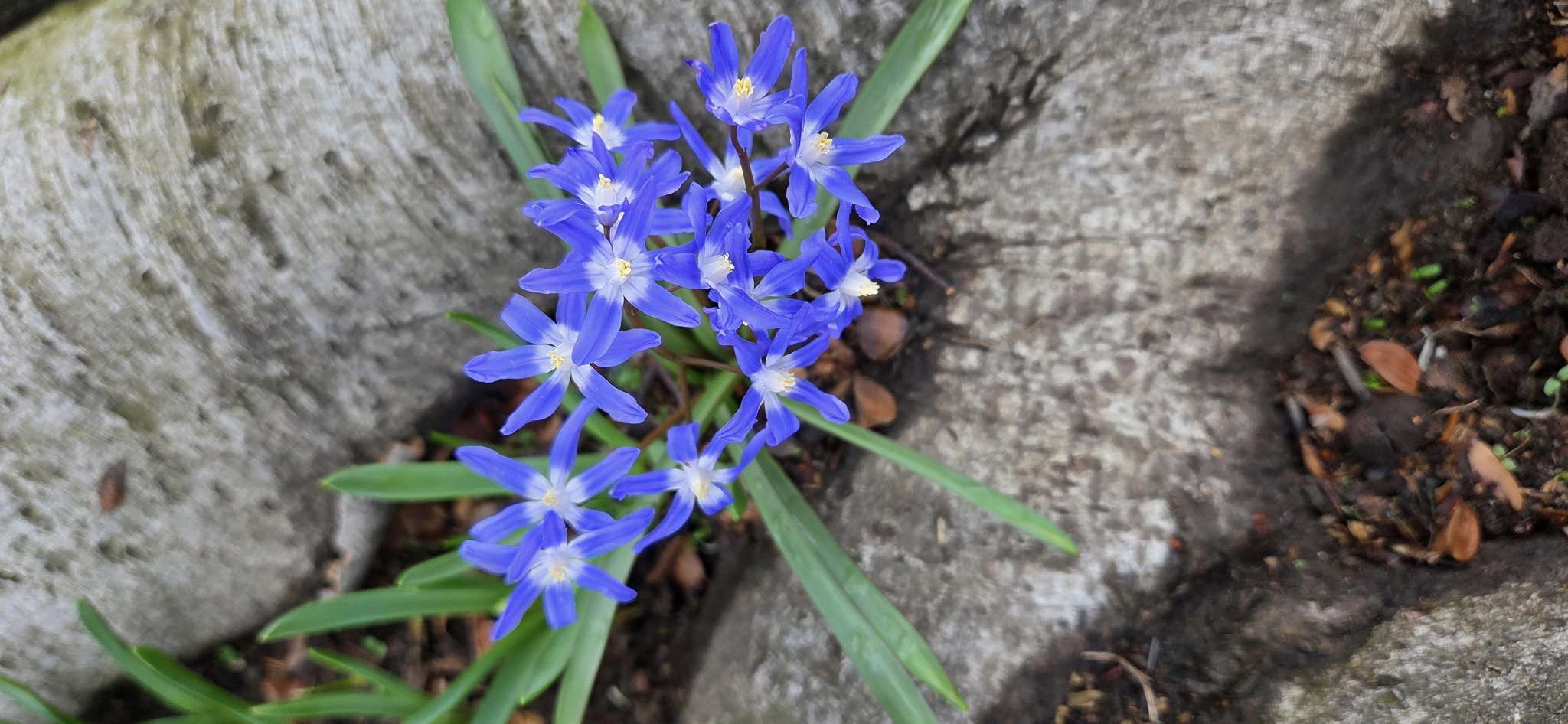
 If you are like me, you are familiar with Chionodoxa or glory-of-the-snow but have not actually grown it. It is one of the many small bulbs in nursery catalogs and is grouped with scilla, muscari, hyacinths, and other late-winter and early-spring bulbs. An email from Ken McFarland brought Chionodoxa to my attention. After a quick internet search to satisfy my curiosity, shrub trimming quickly recaptured my attention for the rest of the day. Thoughts of bulbs were pushed to the background to percolate and process quietly.
A few days later, while talking to Gail Griffin on the phone, she mentioned Chionodoxa. Spurred no doubt by her having read Ken’s SGHS Garden’s post about Anne Spencer’s garden, which, when restored in the 1980s, still had original Chionodoxa planted by Spencer. This conversation piqued my interest again simply because of the way the word sounds when spoken. For me, it is a word that rewards the speaker, encouraging lips to curve upward after a few utterances. It has a strong yet fluid sound, with an appropriate balance of seriousness and quirkiness. Too quickly, my feelings from experiencing a word became associated with the plant itself. I needed to know more. How did it get its name? Where did it call home? When did it join our gardens? And, who has grown it?
My next inquiry, admittedly, was to an AI chatbot to inquire about the origin of the name Chionodoxa. Both roots are Greek: Chion and doxa. Chion (χιών) from ancient Greek meaning snow. Doxa in ancient Greek was a popular opinion or belief. Doxa was later used to translate the Biblical Hebrew word for “glory” in the first Greek translation of the Hebrew Bible or the Septuagint. It then made its way into the New Testament. Doxa in modern Greek, as a result, is closer to glory or honor than opinion. Chionodoxa takes inspiration from this modern meaning of doxa. Chion plus doxa thus translates to glory-of-the-snow, which is also its common name.
Louise Beebe Wilder (1878-1938) succinctly answered several of my other questions in her 1936 book Adventures with Hardy Bulbs. She recounts how three Western Europeans were responsible for naming, introducing, and promoting Chionodoxa. Starting in 1844 with the Swiss botanist Pierre Edmond Boissier (1810-1885), who coined Chionodoxa when he observed a drift of them growing near the summit of Mount Tmolus (Bozdağ) in western Turkey. The Greek roots combined seem apropos if you can imagine the unexpected reward for climbing a mountain was stumbling upon a carpet of blue emerging out of the gleaming white snow. It would be a glorious sight to behold. He honored his wife, Lucile, by naming the species after her, Chionodoxa luciliae. Of course, Boissier did not discover a whole new genus of plants; he simply classified their taxonomy within the Linnaean system, which comes with naming privileges. The habitats of humans and glory-of-the-snow have overlapped for millennia. Certainly, the people living in Turkey, Cyprus, and Crete would have been familiar with the blue and white ephemeral tapestries high in the alpine meadows.
Their brief display is the result of bountiful moisture from the melting snow in an otherwise arid environment. They are a canary singing the alarm of a pending seasonal change, thriving during the transition. The five to eight-inch-tall blue and white blooms perform their procreative function, leaving their sparse and narrow leaves to quickly convert water and sun into energy reserves for next year before they too disappear with the last of the snow. They settle into a slumber, their true bulbs hidden underground for the rest of the year.
While Bossier named Chionodoxa in the 1840s, it was several decades later when the next of Wilder’s characters continued the story. In the late 1870s, it was George Maw (1832-1912), an Englishman, successful floor tile manufacturer, and crocus fanatic, who introduced them to England and into cultivation. Wilder tells us that it was during a plant exploration trip to Turkey searching for crocus that he too discovered large drifts, “describing them as forming one of the most sumptuous displays of floral beauty, a mass of blue and white resembling Nemophila insignis, but more intense and brilliant.” An article in the 1879 edition of The Garden substantiates Wilder, indicating that Maw’s trip occurred a year or two prior, as early as 1877.
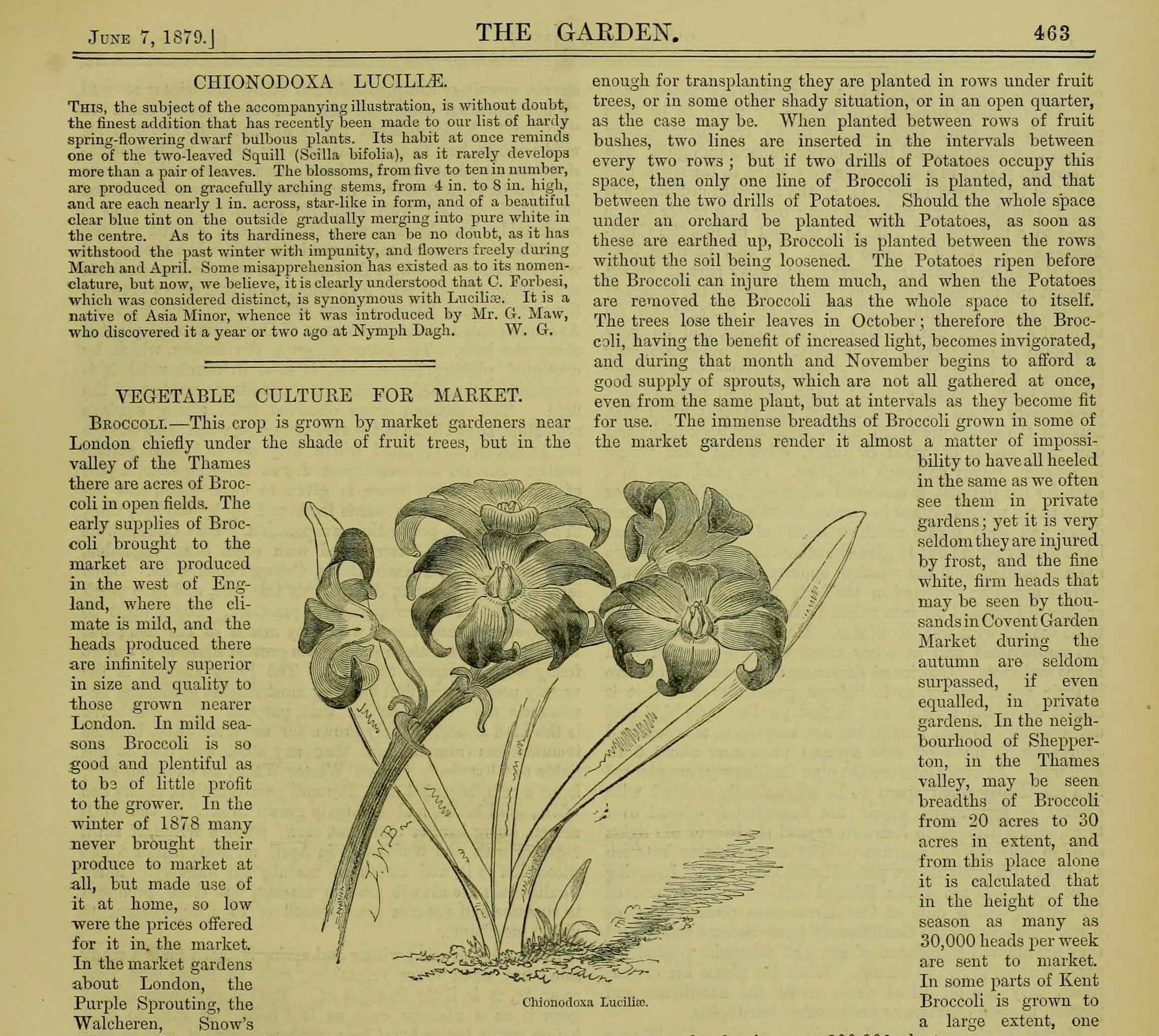
It is not clear how prolifically or diligently Maw’s importation was, but Frances Jane Hope, in her 1881 book Of Gardens and Woodlands confirms Maw sent a few bulbs of C. luciliae to her. She then observed them at the Botanic Garden in Edinburgh. There were likely many plant hunters sending bulbs to England and the continent during this time. The search for new plants around the Mediterranean and into Asia Minor was popular in the late nineteenth century. Maw spent thirty years searching and studying crocuses from Morocco to Turkey, culminating in his 1886 book, A Monograph of the Genus Crocus.
Wilder credits Henry John Elwes (1846–1922) with promoting and popularizing Chionodoxa. Mr. Elwes is well known for his work with Galanthus or snowdrops. The Giant Snowdrop takes its name Galanthus elwesii. Crocus and snowdrops share the same habitats and evolutionary strategies to thrive on alpine slopes, resulting in similar bloom times. As a result, Elwes would have also encountered them on his search for snowdrops. Elwes efforts to showcase a few of the diminutive plants were scoffed at when exhibiting them at a London show. Fair critique, perhaps, if you had not seen a mass planting on a Turkish mountain. Elwes had seen them at their best, though. In 1879, he wrote, “I can say with confidence that it is one of the best, if not, the very best of its class, far surpassing any of the Squills, and apparently as hardy and as easy to increase as Scilla sibirica” (Gardeners’ Chronicle 1879, p. 379).
Elwes makes a bold claim, which I intend to explore for myself in the seasons to come. I currently have a few Scilla sibirica blooming as I am writing this. I have intentions of adding several species of glory-of-the-spring to the garden this autumn, and perhaps a year from now I can form my own opinion. A quick internet search reveals plenty of sources from which to purchase them. Many of the Dutch nurseries carry them in their Fall catalogs and online stores. Large quantities can be purchased rather cheaply. This is convenient because they are best utilized in a mass planting mimicking how they grow in the wild.
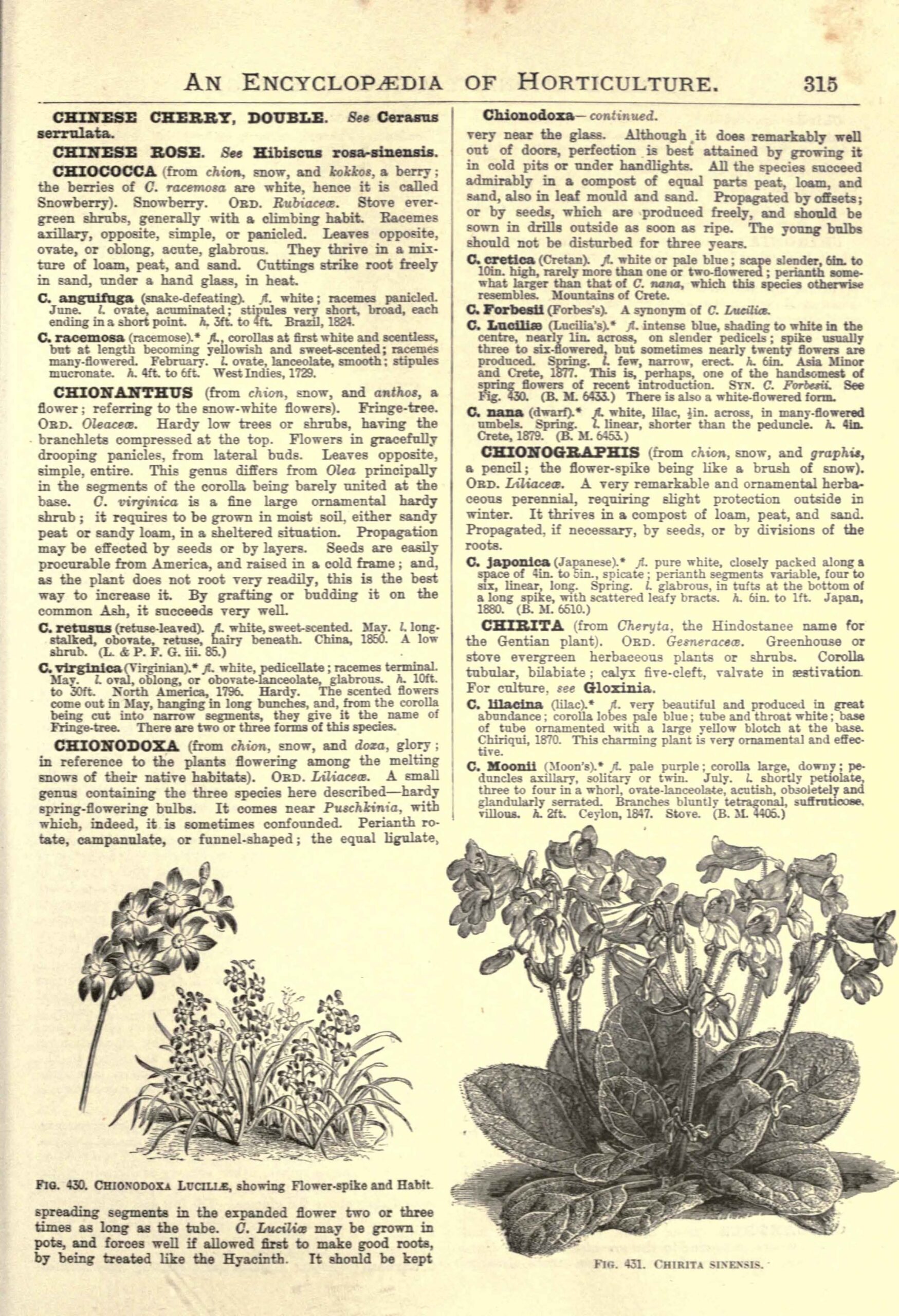
Patience is a virtue, so they say, but gardeners tend to understand their efforts take time to pay off. Glory-of-the-snow apparently does not like disturbance. Their performance the first year after planting may suffer, but it improves in the second year. They reproduce by seed and division and freely naturalize in the South when they are planted in well-drained soils and receive sufficient sun in spring. In an 1884 article in The Illustrated Dictionary of Gardening, readers are warned not to disturb young bulbs for three years. It seems they may reward neglect from gardeners. They were among the short list of original plants that survived the period of neglect before Anne Spencer’s garden in Lynchburg, Virginia, was restored. I started asking all my plant friends who grow Chionodoxa, and one friend noted their Knoxville lawn was full of their blue and white blooms, but they were not thrilled by the inherited naturalizers, calling them messy. Probably advisable to keep them in a woodland or grassy area managed more like a meadow.
Well-informed readers are probably aware that botanists have done what botanists do, and that is, of course, changed their name. I have thus far neglected to acknowledge that the genus Chionodoxa exists no longer; instead, it has been moved within the genus Scilla as a section. Bossier first separated them from Scilla because the bases of their stamens are flattened and closely clustered in the middle of the flower, which differs from Scilla. Unrelated to justifications for separate taxonomic names, Chionodoxa blooms face upwards, while most squill blooms face downward. Genetic and sexual reproduction studies revealed there is insufficient evidence for a separate genus, though.
Outside of botanists, it seems only my AI Chatbot seems to acknowledge the change. The results of any query about Chionodoxa relay the information but diligently tag on the reminder that they have been reclassified. I do not object to this name change; scientists have more resources today than in the 1870s to resolve these matters.
Nurseries selling glory-of-the-snow have not bothered to make the name change. Most still list them as Chionodoxa despite the general acceptance of the name shift over fifteen years ago. Perhaps in another twenty years, the nursery industry will make the shift, and over time, so will gardeners. Today, I will certainly document them in my plant records using the accepted botanical name, Scilla spp., but much like everyone else who seems unconcerned, I will gladly continue calling them Chionodoxa. If only because I prefer saying it to Scilla or squill, and honestly, glory-of-the-snow does not suit me either.

Leave a Reply