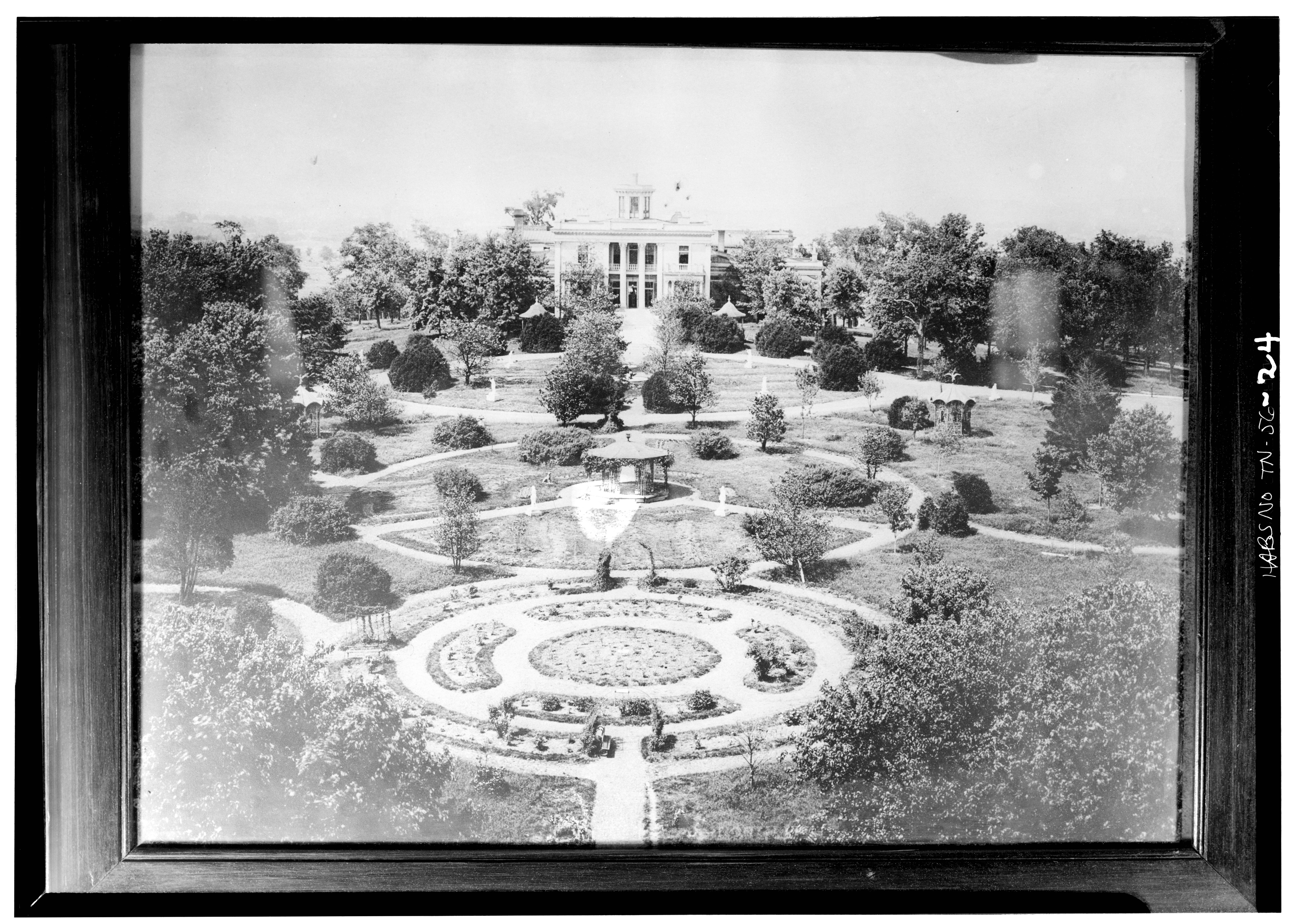
Credit: NPS public domain, HABS TENN,19-NASH,2-24.tif, created 1933.
In The Golden Age of American Gardens Mac Griswold refers to the period just before the Civil War as the South’s first Gilded Age.* She also cites Nashville’s early-1850s Belmont Estate as an especially powerful evocation of that era. This, of course, was in a state that in less than a decade would secede and become part of the short-lived Confederate States of America.
Now incorporated within the campus of Belmont University, the mansion and significant surviving elements of the early grounds were the setting for a Society visit during the 1988 Nashville annual meeting, an event organized by 2026 Flora Ann Bynum Medal winners Ben and Libby Page. This writer left with strong memories of a dwelling (19,000 square feet) outsized even when compared to some of the largest antebellum homes. In turn, it faces a broad slope notable for a finely-crafted central fountain, cast iron gazebos, curving paths, and numerous magnolias. Multiple round parterres joined the paths to remind us of the serpentine and circular patterns predominant in Belmont’s initial design.
Belmont visitors soon learn the story of its owner, the formidable cotton planting doyenne and slave trader Adelicia Acklen. They soon see that her Nashville summer place symbolized in every way this woman who was small in stature but colossal in personality and drive. Owner of several Louisiana plantations including one that would ultimately become Angola Prison, she turned for help with Belmont’s design to Adolphus Heiman, a Prussian immigrant whose life also greatly surpassed the realities of the average day-to-day life.**
To quote Griswold, their efforts would produce gardens with “the showboat glitter and fantasy of the Deep South rather than the Upper South.” Griswold reminds readers, however, that Belmont was underwritten by money generated from Deep South plantations, a fact probably known to the Nashville citizens who were allowed by Acklen to walk the Belmont grounds in public park fashion. They were surely awestruck by such features as multiple greenhouses, including one built at a scale that must have drawn comparisons to the size of Adelicia Acklen’s great mansion. A water tower over one-hundred feet high gave verticality to the setting, while a steam engine helped to keep things growing by pumping the tower’s contents to a sophisticated sprinkling system. Belmont was also something of a zoological park, said at one time to have included a bear house and an aviary.
In pondering Belmont’s many features, it is impossible not to draw comparisons to the Empress Josephine Bonaparte’s early nineteenth-century gardens and elaborate grounds at Malmaison near Paris and indeed to Josephine herself. (To start, both Josephine, daughter of a West Indian sugar planter, and Adelicia Acklen grew up in worlds of staple crop production using enslaved labor.) Just as at Belmont decades later, Josephine enjoyed large greenhouses at Malmaison that allowed her to grow a wide range of tender plants. As well, Malmaison featured an awe-inspiring variety of animals, the Empress gaining particular acclaim for her famous black swans.
It is doubtlessly through their love of roses, however, that the strongest connections can be drawn between Adelicia and Josephine. Said to have an especial fondness for the aroma of moss roses, Adelicia oversaw the planting of hundreds of roses at Belmont. Today’s Adelicia Acklen Rose Garden at Belmont University celebrates that heritage with an array of antique examples including Chinas, Noisettes, moss roses, and teas. Josephine’s roses are recalled most vividly through the paintings of Pierre-Joseph Redouté. Twenty-first century visitors to Malmaison can view examples of Redouté’s work while also being treated to a massive rose collection that has been described as a “spectacular homage” to the woman called in one biography title The Rose of Martinique.***
************************************************************
*For this author’s 1991 review of The Golden Age of American Gardens, see: https://southerngardenhistory.org/wp-content/uploads/1991-Fall-Vol.-VIII-no.-2.pdf#page=9
** https://www.tclf.org/pioneer/adolphus-heiman
***Born Marie Josèphe Rose Tascher de La Pagerie, she went by “Rose” until Napoleon, using her second name, began to call her “Josephine.” The author recommends the biography in question, The Rose of Martinique: A Life of Napoleon’s Josephine, by Andrea Stuart.

Leave a Reply