
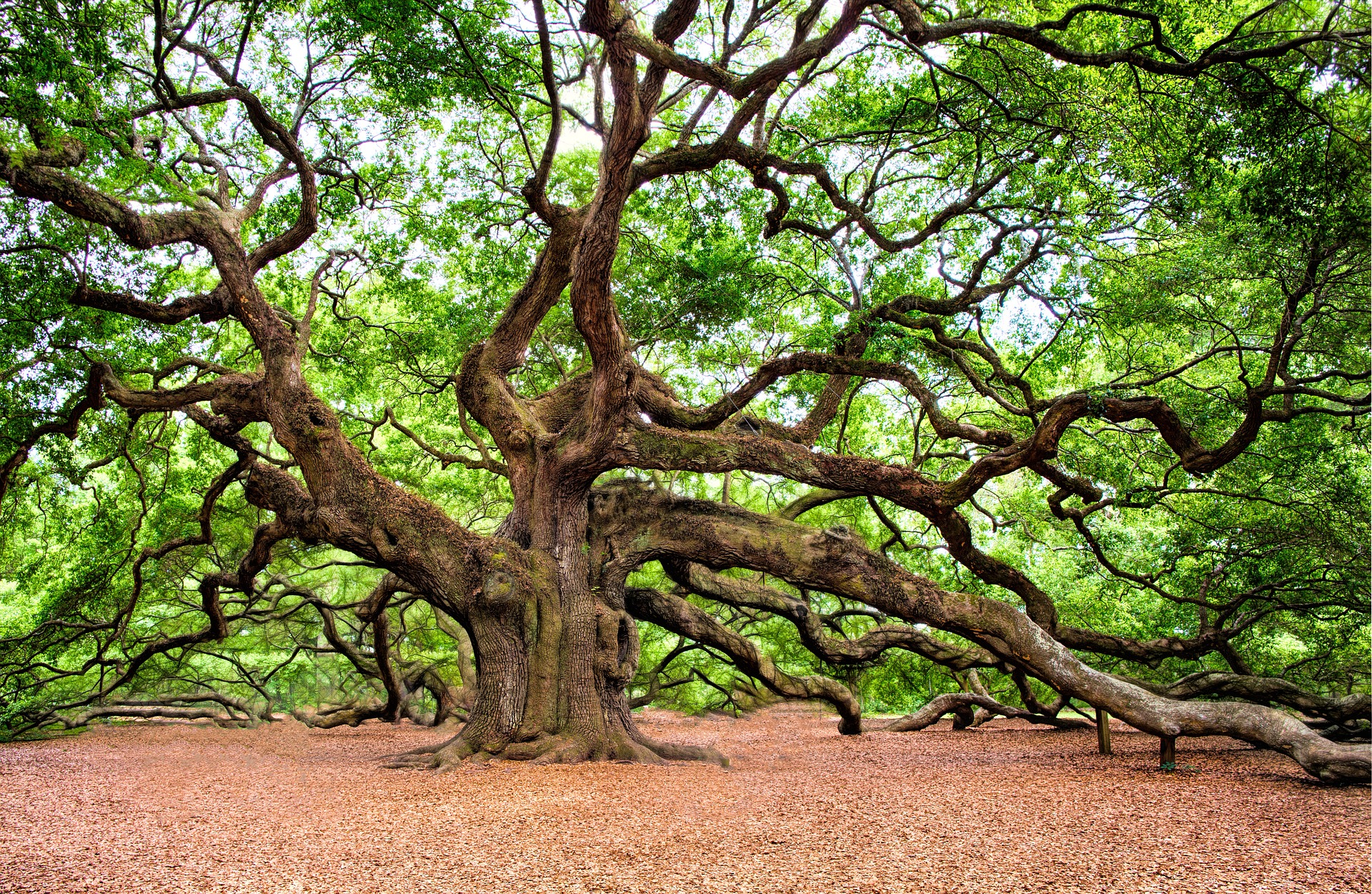
Credit: Wikimedia Commons Creative Commons Zero, https://pixabay.com/photo-2018822/
The Gardens post of February 2, 2026, began a review of Frederick Law Olmsted’s (FLO) landscape observations made during his journeys across the American South as a New York Daily Times reporter during the years 1852, 1853, and 1854. This post continues that examination beginning with FLO’s observations, writing under the name “Yeoman,” after he departed from Wilmington, North Carolina, and while he traveled in South Carolina and Georgia. It begins with Charleston, where Olmsted arrived on either January 20 or 21, 1853.*
We now think of Charleston as a city of gardens, and indeed in his Times Post #22 Olmsted spoke almost fulsomely of rural scenes near town which included “beautiful park-like ground, with a planter’s mansion,” along with sizeable “market gardens” where radishes, turnips, and cabbages were being grown. Vegetation characterizing this area also included live oaks, hollies, and magnolias, along with “roses twining among palmettos…”
Olmsted’s notes on the landscape within Charleston, however, bear little connection to today’s perceptions. Instead, he observed that it had a “ruffianly character,” and that the high level of military activity in Charleston “might lead one to imagine that the town was in a state of siege or revolution”…a prescient forewarning of the brutal war just on the horizon. Though he spent several days there, Olmsted thus regrettably omitted any discussion of Charleston’s antebellum designed landscapes or of horticultural practices of possible interest to garden historians.
The Times reporter soon arrived in Savannah, afterwards travelling along what he termed the “rice coast.” In Savannah, unlike Charleston, he found time to describe, though briefly, the city of squares known so well to SGHS members, noting the town’s detached houses, gardens, courts, squares, shade trees, and shrubberies. He excused the absence of greater detail, saying that the city was too well known to require more.
While exploring nearby plantations, however, Olmsted returned to making detailed landscape observations as well as to describing the area’s flora, both wild and cultivated. Thus, on his way to visit a fellow New Englander, Rhode Island native Richard Arnold, Olmsted stopped briefly at Richmond Plantation where he experienced an allée of live oaks. This was one of his favorite Southern landscape features, and readers can still share his excitement in the following recollection: “I stopped my horse, bowed my head, and held my breath. I have hardly in all my life seen anything so impressively grand and beautiful.”** At another brief plantation stop he observed “an avenue of Pride of China trees, fifty feet wide.” This recollection, however, enlicited no such enraptured words as FLO’s live oaks evocation.
Ultimately reaching Richard Arnold’s home, Olmsted entered via a “very broad” approach set in a pine forest and “lined with a dense screen of water oaks, wild olives and cedars.” The house itself was set in a grove of live oaks and magnolias, along with an accompanying array of ornamental plants that included camellias, oranges, and roses. Also offered was a detailed description of the enslaved community, FLO again showing his skill at verbally capturing a landscape. Ranged along a street two-hundred feet wide, the whitewashed forty-two by twenty-one-foot buildings housed two families, each averaging five people. Between each house was “a small piece of ground, inclosed (sp) with palings, in which are coops of fowl with chickens, hovels for nests, and for sows with pigs.” Vegetable gardens were to be found in the rear, while most of the swine ranged freely in the woods.***
Departing Savannah on February 1, 1853, Olmsted journeyed west across Georgia by rail and stage, arriving in Columbus only twenty-four hours later. (The traveler found the quality and efficiency of the trains and coaches remarkably good, a situation he ascribed to their construction and management by Northern entrepreneurs.) He observed in Columbus a landscape of industry set at the falls of the Chattahoochee River, such endeavors happening at a level reminiscent of what he had seen in Richmond. This was chiefly cotton goods manufacture, the mill the workers being mainly poorly-paid young white women from the surrounding country side. Olmsted found little to his liking about Columbus, remarking on his dirty accommodations, plus the level of intoxication and gambling he witnessed.
In a seemingly contradictory vein, however, he commented: “I met with much courtesy from strangers, and saw as much real hospitality of disposition among the people near Columbus, as anywhere in the South.” One such welcoming Georgian was “Mr. Peabody, a horticulturist, who has succeeded wonderfully in cultivating strawberries upon a poor, sandy soil, in a climate of great heat and dryness, by a thin mulching of leaves.” Surely the visitor and Mr. Peabody struck up an interesting conversation, as Olmsted would doubtlessly have mentioned personal fruit growing activities at his own 130-acre Tosomock Farm on New York’s Staten Island.****
From Columbus FLO moved on to Montgomery, Mobile, and New Orleans, experiences that will be discussed in another Gardens post. Meantime, readers are highly encouraged to expand their knowledge of these important first-hand looks at the Antebellum landscape via sources cited below.
*********************************************************
*https://southerngardenhistory.org/wp-content/uploads/2015/12/Magnolia_Fall_2006.pdf#page=1
**These and other quoted lines are taken from The Papers of Frederick Law Olmsted, Vol. II, Slavery and the South, Beveridge, McLaughlin, and Schuyler editors.
***A further excellent resource used here is Olmsted’s A Journey in the Seaboard Slave States https://docsouth.unc.edu/nc/olmsted/olmsted.html

Leave a Reply