
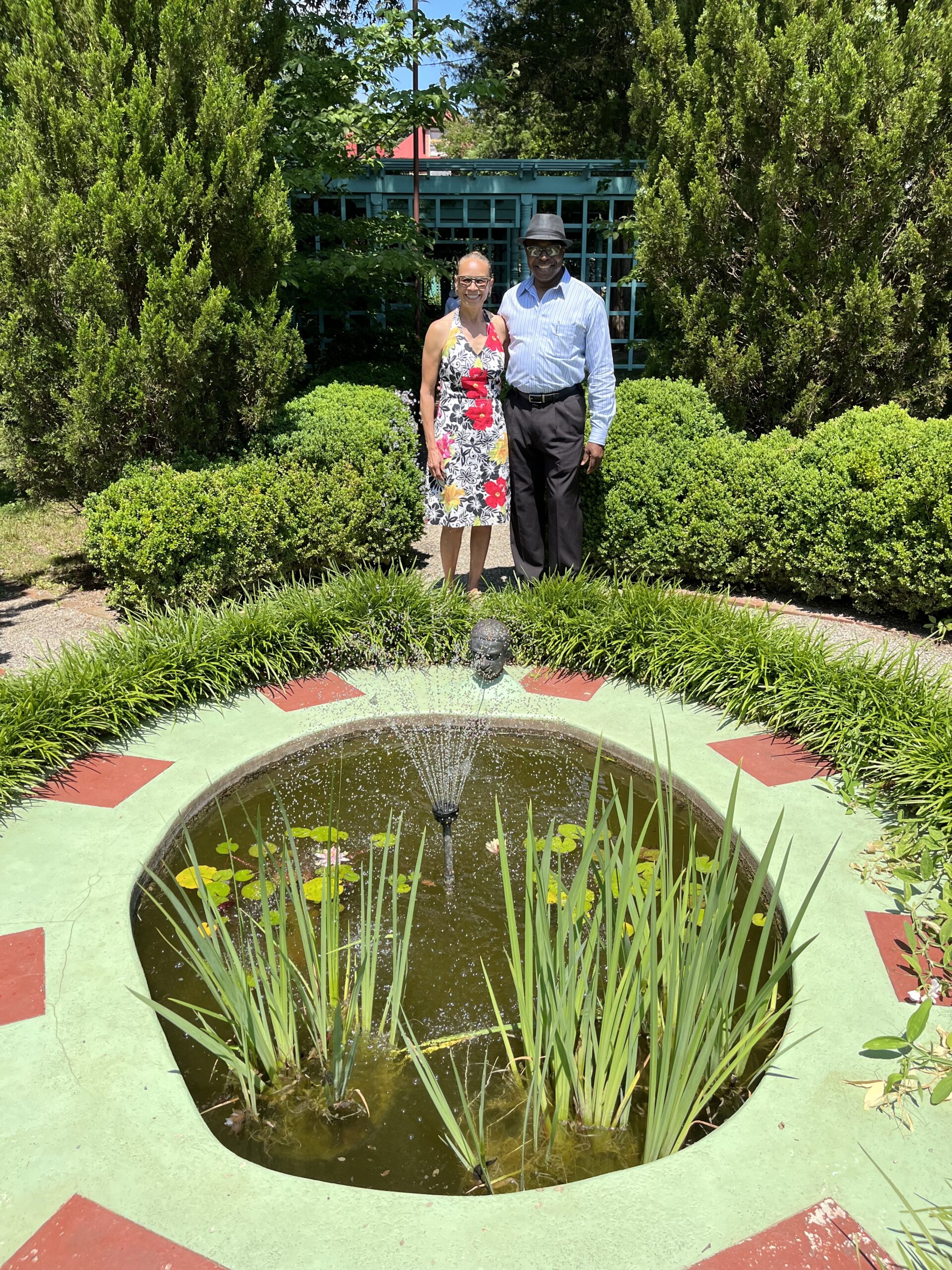
Photo credit: Peggy Cornett
Several Gardens posts have explored the Southern home sites of prominent artists, including Gari Melchers in Falmouth, Virginia, and Eudora Welty in Jackson, Mississippi. This essay and the Gardens entry of February 21, 2026 continue such an artist’s garden discussion through a look at the personal Eden of Harlem Renaissance poet Anne Bannister Spencer and her husband Edward Spencer, the latter being Lynchburg’s first African American U. S. Post Office parcel post carrier. This essay also allows SGHS to observe Women’s History Month 2026 and is meant as a particular tribute to Anne Spencer, her granddaughter Shaun Spencer-Hester, and to our former Society board member Jane Baber White.
The February 21 post focused on Spencer-related Magnolia writings, while also referencing further resources in either a print or a video format. Among the latter, though not mentioned previously, is the Garden Conservancy’s new film Earth, I Thank You: The Garden and Legacy of Anne Spencer which offers a particularly fine addition to the documentation available online for students of the Spencer landscape legacy.*
Of course, nothing tops a personal visit such as our SGHS group enjoyed on May 4, 2013, where we experienced a garden reflecting two periods of restoration and rejuvenation. The first project began in 1983 guided by Jane White and aided by Lynchburg’s Hillside Garden Club, Anne Spencer descendants, and other caring members of the community. More work followed in 2008. This, we discovered, is a garden representing extraordinary achievement by its creators but one that is also small enough in scale to make an inspired visitor believe “perhaps I can do this too.” Measuring 150 feet by 45 feet, it consists of four rooms: a rose garden, a cottage garden, an arbor garden, and a pond garden, such division thus reflecting the Arts and Crafts influences prevailing during this garden’s earlier days.
During our Society pre-tour introduction, we learned that the garden of 2013 did not completely replicate the exploding-with-plants spot visited by such well-known guests as W.E.B. DuBois, along with Spencer’s fellow poets Sterling Allen Brown and Langston Hughes, as well as Marion Anderson, H. L. Menken, George Washington Carver, Thurgood Marshall, and Martin Luther King. While 1980s restoration work aimed to capture the essential form and spirit of the garden these famous persons enjoyed, it also sought to lessen maintenance demands so that volunteers might reliably undertake the work. Thus, modern visitors experience fewer and therefore easier-to-maintain plantings, yet they find a garden Anne and Edward Spencer would still handily recognize.
Walkabouts here start at the rose garden. Among the first tasks of the 1983 restoration project was to give the many surviving but overgrown Spencer roses major amounts of love and care. Indeed, returning these roses to a flourishing state offers a remarkable story within a story of this project. Along with Jane White, someone key to the Spencer roses recovery was her Lynchburg friend Carl Porter Cato, a cofounder in 1975 of the Heritage Roses Group. Cato, in turn, used his deep knowledge of roses to help identify Spencer examples, as Jane White recalled in 2022, based solely on their individual “prickles and stems.” Among those were Aloha, American Pillar, Spanish Beauty, Crimson Glory, climbing Crimson Glory and climbing American Beauty.** About this spot, however, Anne Spencer says it best:
“This small garden is half my world
I am nothing to it—when all is said,
I plant the thorn and kiss the rose,
But they will grow when I am dead.”
“Any Wife to Any Husband, A Derived Poem” Anne Spencer***
Set a few steps beyond the roses is the stone writer’s cottage built by Edward and named by the Spencers Edankraal (EDward, ANne, kraal, Afrikaans for enclosure). Filled with books, photos, and cherished mementos, the building’s single room evokes strong images of Anne Spencer’s life as poet, gardener, educator, and civil rights activist. Adjoining Edankraal are a sturdy pergola and trellis (painted in a standout light blue) that support wisteria and grape vines. (Anne Spencer’s descendants recall that the grapes were there not for family enjoyment but as nourishment for birds. These included most particularly numerous purple martins, for which Ed Spencer built special houses and thus gained the family additional fame.)
Lastly, Anne, Edward, and their guests found quiet and rejuvenation by the pond and fountain at the garden’s far end. Classically symmetrical in layout, this fourth room was centered on a circular concrete pool terminating the garden’s central axis and accessed by a shrub-lined walk. Reflecting the garden’s golden years most poignantly, however, is a cast iron African head found at the pond’s edge, a gift to the Spencers by W.E.B. DuBois and named by Anne “Prince Ebo.”
The Spencer garden today demonstrates the universal truth that change is life’s only constant. For instance, the continuing growth of a red oak and pecan, while offering more welcome shade for visitors, also restricts the sunlight demanded by roses and other plants long prominent here. Every garden problem has a solution, however, and doubtlessly the Anne Spencer Foundation and its many friends will continue in the Anne Spencer tradition in making this a place of beauty, enjoyment, calm, and reflection. ****
*******************************************************************
*https://www.gardenconservancy.org/films/spencer
** https://southerngardenhistory.org/wp-content/uploads/Magnolia_Spring-22-Final.pdf#page=8
***https://southerngardenhistory.org/wp-content/uploads/2015/12/Magnolia_Summer_2005.pdf#page=7

Leave a Reply