
Credit: Wikimedia Commons, https://www.flickr.com/photos/boston_public_library/8342840015/
Author: Tichnor Brothers Inc.
Over the afternoon of Friday, April 11, 2008, Society members explored the University of Georgia (UGA) North Campus during that year’s Athens-based annual meeting.* (A previous Gardens post noted how a morning talk by UGA Professor John Waters left us well prepared for that visit.) The North Campus spans a large area embracing a variety of component landscapes, however visitors often find that the two-and-one-half-acre Founders Memorial Garden tops their list of favorites places.
Primarily dating to the period from the late 1930s to 1946, the garden honors the twelve founders of the Ladies Garden Club of Athens, an organization organized in 1891 and notable as America’s first garden club.** As well, it memorializes those who died in World War II. Underwritten by funds from the Garden Club of Georgia (GCG) the site is inseparably linked to the UGA’s College of Environment + Design (CED) by physical proximity; by the history of its design and installation; and by its ongoing use as a living laboratory and socializing area for CED students and faculty.
Initial credit for the Colonial Revival design and construction oversight goes to Hubert Bond Owens, who was singled out in our October 3, 2025, Gardens post as being the 1928 founder of UGA’s landscape architecture program. Laid out in a set of distinct rooms, the garden as a whole is clustered around the late-antebellum Lumpkin House, the first home to UGA’s landscape architecture program.
As noted in Staci Catron and Mary Ann Eaddy’s Seeking Eden, the earliest phases of installation began with the courtyard and boxwood gardens set immediately off the southeast corner (rear) of the Lumpkin House. Surely the most photographed area of the Founders Garden, the latter is circular in its highly formal design, set within a picket fence, and centered on a sundial. Apropos of the name, it features closely pruned quarter-round boxwood parterres, each enclosing topiary creations symbolizing plants important to Georgia. The designer provided added dignity by incorporating the brick GCG memorial building (the original Lumpkin smokehouse) at the east edge of the courtyard and overlooking the boxwood garden from the west.
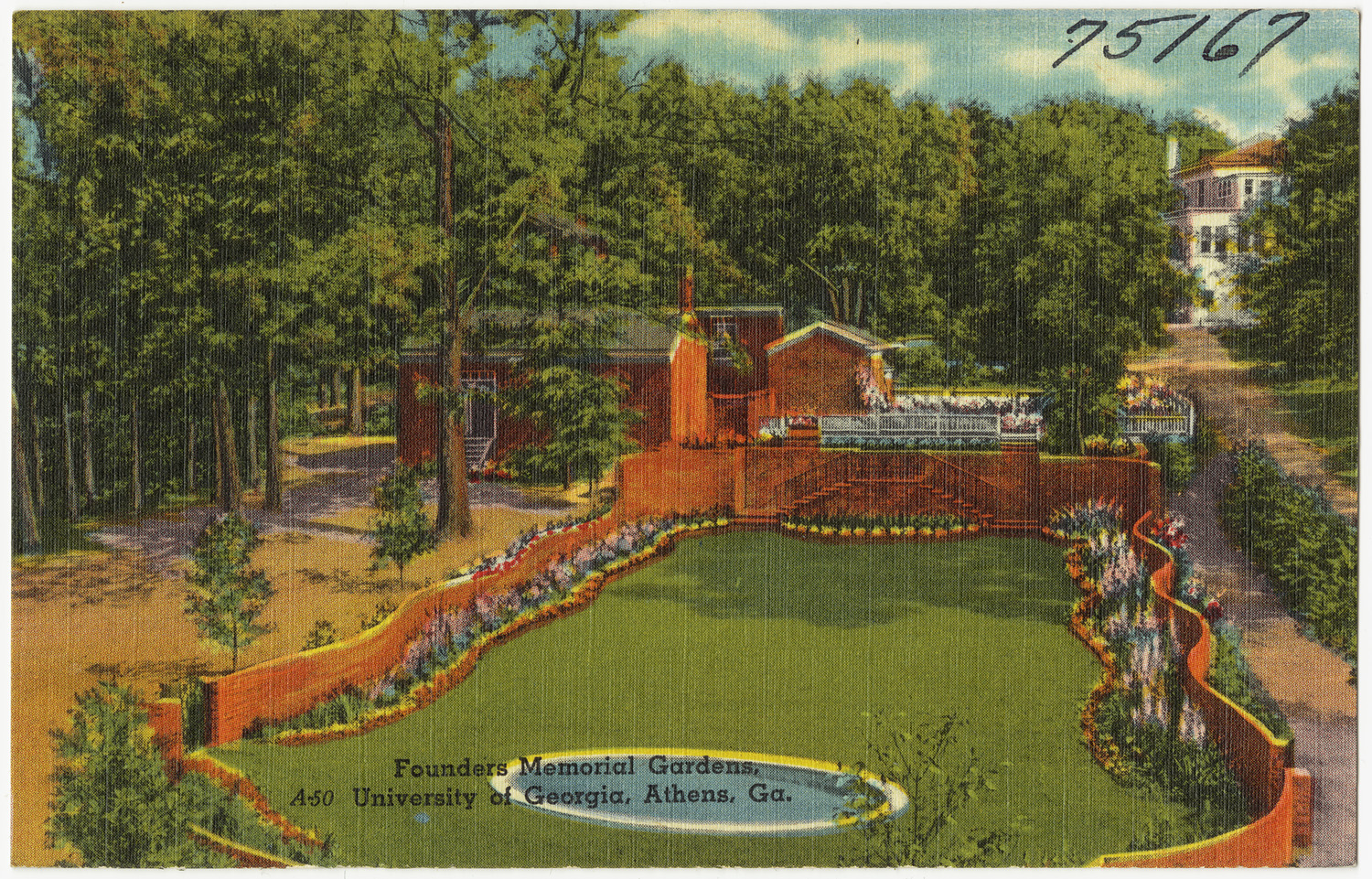
Expansion continued apace, and by 1941 both the terrace and perennial gardens were in place to the immediate south of the boxwood garden. Set within an unobtrusive brick wall and featuring bordering beds displaying a variety of bulbs and other flowering plants, the former is a well-shaded area sometimes termed the overlook garden for the view it offers of the perennial garden just below. For many visitors perhaps the most memorable area within the Founders Garden, the perennial garden features such signature elements as the double brick stair offering access from the terrace on the north, the stair being notable for its fine iron rail and female statue rising from a tall plinth centered at its base. Owens defined the space between the stair and an oval pond at the opposite end with a large grass lawn edged by undulating perennial beds, all set within serpentine brick walls. The designer also called for the use of Magnolia grandiflora (since replaced with another magnolia variety) for height, mass, and screening to the very outer borders of this garden. Period documents indicate that Owens saw this as an area where students might experiment with any number of newly introduced plants. (Seeking Eden, 326.)
As the war was nearing its end in 1945 others joined a team that would expand the Founders Garden beyond the four-room pattern then in place, including recently hired landscape architect and Cornell graduate Brooks Wigginton.*** Following a proposition made by GCG president Louise Neely, an additional one-and-one-half acres on the Lumpkin Street (north and west) side of the property would be developed as an arboretum that would serve as both an experimental zone for CED faculty and students, as well as a memorial to American services lost in the recent conflict.
Readers are directed to Seeking Eden, along with online resources, for further details on the arboretum project and other developments that have unfolded since the 1940s. It would be remiss, however, not to single out the gratis restorative and rejuvenation work done there in 1988 by long-time Society member, CED graduate, Georgia landscape architect, and World War II veteran, Dan Franklin. Highly generous to his alma mater, he posthumously received the distinction of having the Dan B. Franklin Distinguished Professorship named in his honor.****
**********************************************************
*https://southerngardenhistory.org/wp-content/uploads/2015/12/Magnolia_summerfall_2008.pdf#page=8
** https://gardenclubofgeorgia.org/about-us-founders-memorial-garden/
***https://www.tclf.org/pioneer/brooks-e-wigginton
****https://give.uga.edu/story/dan-b-franklin/
Recommended reading: Staci L. Catron and Mary Ann Eaddy (photography by James R. Lockhart), Seeking Eden: A Collection of Georgia’s Historic Gardens, 321-331 .

Leave a Reply