
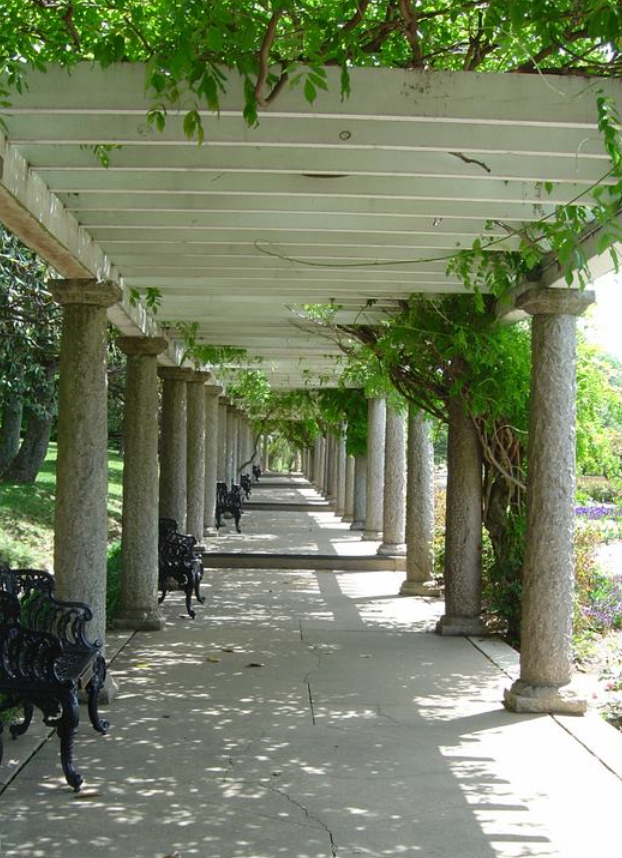
Credit: Wikimedia Commons, Creative CommonsAttribution-Share Alike 4.0 International author Mitzi.humphrey
In June 2012, Society members visited Richmond for our thirtieth annual meeting, an event based at the famous Jefferson Hotel and organized under the guidance of Past President Dean Norton. The setting for a series of introductory talks, the hotel has a downtown location that offered ready access to tour destinations spanning Virginia’s capital.* The Gardens post of November 19, 2025, examined Hollywood Cemetery, one well-known site visited in 2012. Others not previously discussed, however, include Maymont, which numbers among the most popular and significant examples of a Richmond public landscape.
Maymont’s Peggy Singlemann (then director of horticulture and now retired as director of park operations and horticulture), offered a pre-visit look in a talk titled “Gardening in her Footsteps and Wishing I had her Budget,” cleverly named to underscore both the great wealth underpinning a one-hundred-acre late Gilded Age estate and the funding tribulations faced by those charged with its management in the twenty-first century. The twice-repeated “her” referred to Sallie May Dooley, wife of the prominent Richmond lawyer, politician, and business leader James H. Dooley. The couple began life at their new home in 1893, the designation “Maymont” coming from Sallie’s middle name and the knoll-top setting of a house termed a “turreted stone castle” in the seminal book The Golden Age of American Gardens.**
Over the following two decades the Dooleys shaped their grounds in a manner that reflected their affluence along with the eclectic tastes of the era. Like Hollywood Cemetery less than two miles east, Maymount is bounded on the south by the James River and Kanawha Canal, with the James River itself flowing just beyond. The sloping ground between house and canal offered a variety of design opportunities for the owners’ consideration. Not surprisingly, the Dooleys joined the ranks of many other Americans who toured Italy and returned highly impressed by the country’s villa gardens. Thus, they charged the Richmond firm of Noland & Baskervill for guidance in laying out a ca. 1910 terraced garden that was influenced heavily by the Villa Torlonia in Frascati near Rome.
The result was a highly articulated spot southeast of the Dooley home characterized by a long pergola terminating in a domed summer house, this being bordered by a series of parterres and containing the variety of sculptural elements such as stone walls, urns, a gazebo, etc. that bespeak Italian gardens. Several water features closely mimic those found at the Villa Torlonia, the most striking being the fountain court and a replica of Torlonia’s multi-level cascade sonorously terminating in a semi-circular basin. (The Golden Age of American Gardens reminds us this is wonderfully known in Italian as a catena d’acqua or simply a “chain waterfall” in English.) Reflecting the care Maymont’s staff devotes to the horticultural side of affairs, the garden includes not only the requisite well-pruned evergreen shrubs but also a wide array of flowering plants (roses having a strong presence) reflecting seasonal change, their color and form rewarding repeated visits over the span of a year.***
With the Italian Garden as a landscape centerpiece, Sallie and James Dooley shifted their focus from Europe to the Far East, engaging designer Yonehachi Muto to create a Japanese garden for Maymont. Abutting the canal southeast of the Italian Garden, it would offer the calm, contemplative, and shady areas for which such spaces are noted.**** Fittingly termed a stroll garden, its six-plus acres include such requisite components as a waterfall (majestic in scale), winding brook, arched bridges, koi pond, and stone lanterns, along with trees, shrubs, and other flora commensurate with Japanese-style landscapes.
Known for their generosity as well as their wealth, the Dooleys went on to bequeath Maymont to the City of Richmond for public enjoyment. Ownership thus passed in 1925 following Sallie’s death, a full page in the “Gravure Section” of the September 27, 1925, Richmond Times-Dispatch being devoted to photographs celebrating Maymont as a “Gift to the City.” Over the coming years the property went through periods of decline, renewal, and restoration, a crucial turning point coming with its acquisition by the nonprofit Maymont Foundation in 1975.
Unfortunately, our 2012 Friday afternoon visit to Maymont was curtailed by thunderstorms forcing a retreat to the adjacent Robins Nature Center for a tented dinner under continuing rain. Those with area ties, however, will probably have visited Maymont either before the 2012 meeting, or afterwards, or both. They will thus know there is more to experience than the Italian and Japanese Gardens, including an arboretum, a wildlife trail, the Nature Center, and, of course, the Dooley’s “turreted stone castle.” Perhaps a future meeting will present the opportunity for a good walk-about for those who have so far missed out.
*********************************************************
*For former board member Susan Hitchcock’s thorough review of the meeting, see: https://southerngardenhistory.org/wp-content/uploads/2015/12/Magnolia_Summer2012-1.pdf#page=8
**Mac Griswold and Eleanor Weller, The Golden Age of American Gardens, 207.
***Given the important place the Italian Garden holds at Maymont, the reader may enjoy this virtual tour: https://www.youtube.com/watch?v=eurPv07yUMU
Among other interesting details, it reveals this was chiefly a spring garden for the Dooleys, as summers were devoted to their extensive travels. Almost certainly the couple possessed Edith Wharton’s Italian Villas and their Gardens, its opening pages including an illustration of the Villa Torlonia’s famed cascade.
****For details on the work of Yonehachi Muto, see: https://www.morrisarboretum.org/sites/default/files/2024-07/Muto%20Profile%20%20source%20links.pdf

Leave a Reply