Credit: Wikimedia Commons; author, Nilebreanna; license, Creative Commons Attribution-Share Alike 4.0 International
When SGHS held its New Orleans annual meeting in 2004 we were already marking twenty-one years since 1983 and the first such gathering in Atlanta. The Crescent City was a fine spot to celebrate a coming-of-age moment, and those present will always appreciate the hard work of a planning group headed up by meeting co-chairs and SGHS board members Sally Reeves and Betsy Crusel.
While they had arranged visits to properties in the French Quarter and the Garden District, two sites figured prominently among the scheduled tours: Longue Vue and the New Orleans Botanical Garden (NOBG) at City Park. Offering morning previews of the two locations were Ellen Shipman scholar Judith Tankard who addressed Shipman’s work at Longue Vue (See the Gardens page post for November 8, 2024) and Afton Villa owner Genevieve Trimble, who had played a key role in the restoration of the NOBG.*
To help understand the NOBG’s origins our speaker first offered a look at the beginnings of the New Orleans City Park, a site which at thirteen-hundred acres today encompasses half again as much ground as Central Park in New York. Over the first half of the nineteenth century the core property was a sugarcane plantation owned by Louis Allard, but owing to Allard’s financial woes ownership passed in the 1840s to the wealthy merchant and land speculator, John McDonough. He then willed the land to the city in 1850, stipulating its use for public enjoyment. Over the following years it became a park offering such attractions as a lagoon for boating, a golf course, a carousel, a racetrack, a swimming pool, and the Delgado Museum of Art (now the New Orleans Museum of Art).
A monumental leap came in 1925 when the City of New Orleans acquired 1,200 brush-entangled acres between the existing park and Lake Pontchartrain on the north. The key to real progress, however, occurred in the next decade with the creation of a master plan by the Chicago firm Bennett, Parsons & Frost and receipt of a twelve-million-dollars appropriation from the Works Progress Administration, a Federal New Deal agency. The August 6, 1933 edition of The Times-Picayune offered readers a look at the scale of work then underway, noting that “an average of 2000 men a day has been working at clearing the tract, at building roadbeds, and at laying out the lagoon system.” At that moment two-hundred acres had been cleared, and a “new 18-hole golf course (had) been staked out.”
The park area that officially became the New Orleans Botanical Garden in the 1980s (a period of improvement and rejuvenation) was initially designed and installed as part of this pre-World War II City Park expansion work. Its genesis is linked primarily to Cornell-trained landscape architect William S. Wiedorn, architect Richard Koch, and sculptor Enrique Alférez, with their ideas taking shape in what was termed the Rose Garden, laid out in a classically formal parterre seven-acre setting.** In her Gardens of Louisiana Suzanne Turner notes that Koch used his knowledge of early Louisiana structures to design garden service buildings, including various sheds and cold frames.***
Over time, however, the footprint has grown from what is still termed the 1936 “Original Garden” to ten acres, while the site is enhanced by the renovated 1930s conservatory, the Pavilion of the Two Sisters events center, and the popular Yakumo Nihon Teien Japanese garden to name but several site features. Roses still have a strong presence at NOBG, but guests also appreciate the welcoming shade of its venerable live oaks, along with an expansive plant array including but not limited to Louisiana natives, flowering plants, shade loving specimens, vegetables and herbs, and tropical flora.
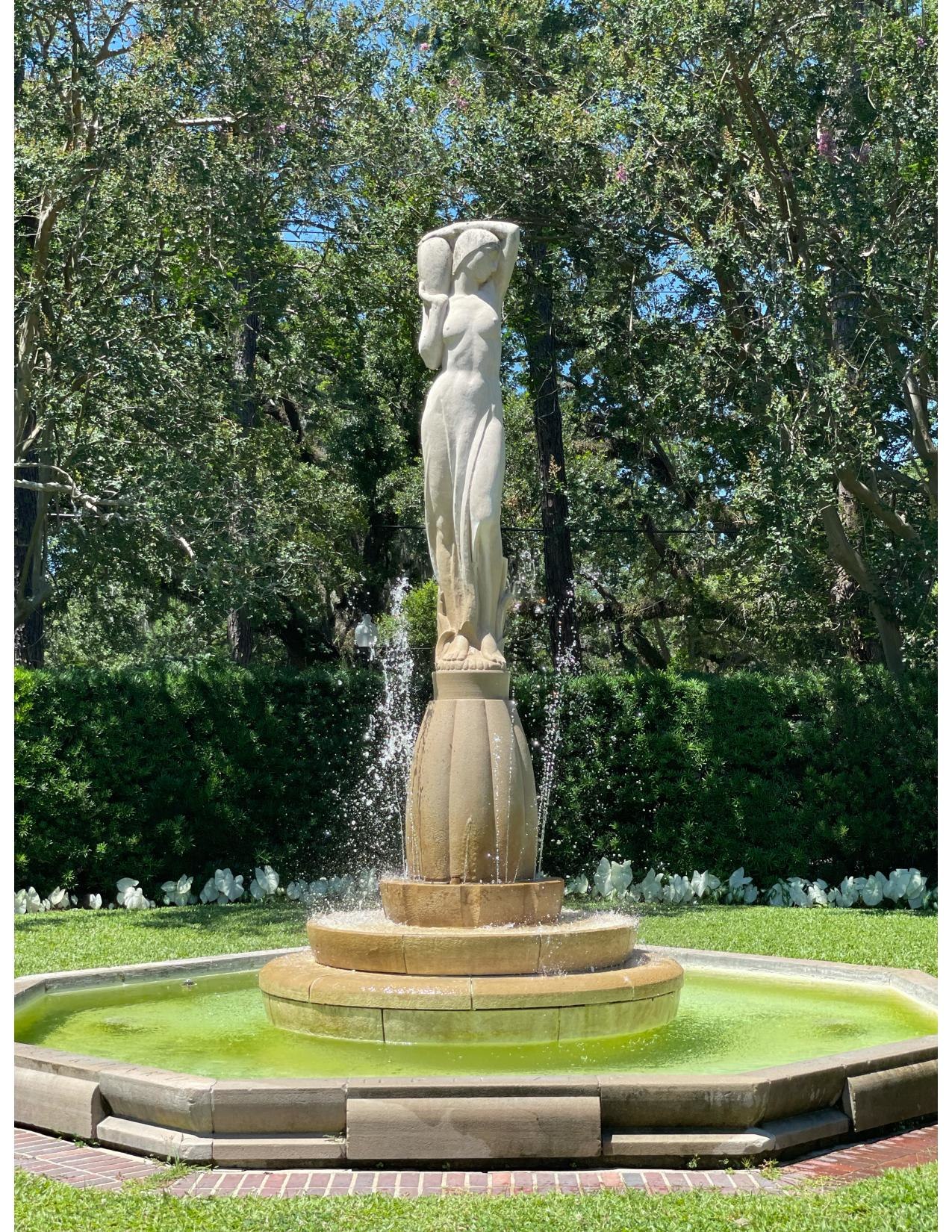
The sculptures and iron work crafted by the long-lived (1901-1999) Enrique Alférez stand out as hardscape features that have been appreciated by countless visitors over many decades. Dating from the 1930s to the 1990s, they give the Botanical Garden its widely applauded Art Deco flavor. However, while Alférez executed most of this outstanding work, perhaps the best-loved sculpture is Marie Huth’s “woman riding a fish.”
Readers will recall that the year following our 2004 visit Hurricane Katrina delivered devastating blows to New Orleans gardens, City Park numbering among those suffering immense damage. The lead article in the Fall 2005 issue of Magnolia noted that “90% of the park was under anywhere from one-to ten-feet of water and approximately 40% remained underwater for several weeks.” This was salt water, moreover, “which killed all the grass and most of the tender vegetation” at NOBG. Recovery efforts, however, were nothing if not Herculean, a process described by the now-retired Botanical Garden director Paul Soniat during the 2007 Restoring Southern Gardens and Landscapes Conference.****
************************************************************
*Genevieve Trimble’s 1980s efforts at NOBG were recalled by Randy Harrelson in Magnolia. See: https://southerngardenhistory.org/wp-content/uploads/Magnolia.2023.XXXV_.4.pdf.pdf#page=11
**For more Wiedorn and Koch, see: https://www.tclf.org/pioneer/william-wiedorn and https://southeasternarchitecture.blogspot.com/2008/08/richard-koch-1889-1971.html
***Suzanne Turner, text; A. J. Meek, photographs, The Gardens of Louisiana: Places of Work and Wonder, “New Orleans Botanical Garden,” 171.
**** https://southerngardenhistory.org/wp-content/uploads/2015/12/Magnolia-fallwinter20072008.pdf#page=8

Leave a Reply