Credit: Billy Hathorn, photographer, Wikimedia Commons, Creative Commons Attribution 3.0 Unported
The location of two annual meetings, Charleston has also drawn the repeated attention of Magnolia contributors while being the central focus of two books written by our former president, James Cothran. Sometimes termed the “Holy City” because of its large number of churches, it is also the home of our current president, Derek Wade, and our vice president (and thus president-elect), Susan McLeod Epstein. For these and other reasons discussed below, it is hard to overplay the importance to SGHS of this house-and-garden-filled peninsular community where the Ashley and Cooper Rivers merge, as well as its overall place in Southern landscape history.
In fact, an initial link was established during the first “Restoring Southern Gardens and Landscapes” (RSGL) conference held in Winston-Salem in 1979. Predating the formation of SGHS by three years, the program featured a talk by University of South Carolina history professor George Rogers, Jr., on “Plant Materials and Gardens of Early Charleston.” Also present in 1979 to carry the Charleston message, though not a speaker, was Charles Duell whose preservation endeavors at Middleton Place were in their earlier stages.*
While the early 1980s saw much of the RSGL and SGHS focus going to Georgia, North Carolina, and Virginia sites, it was the impressive work of Mary Palmer Dargan and founding board member Hugh Dargan that helped to turn the Society’s attention to Charleston. The Dargans drew special notice in the Winter 1989 issue of Magnolia for their work at 58 South Battery, a project for which they had received a historic preservation award of merit from the ASLA South Carolina Chapter. (The Magnolia article also notes that former SGHS board member Jane Symmes consulted on plant selection here.)** Termed a “classical Charleston garden,” the South Battery project was singled out for attention by Penelope Hobhouse in Garden Style as well as in Jim Cothran’s Gardens of Historic Charleston.*** Identifying it as the “Hanahan garden” Cothran includes a site plan along with verbal descriptions and photographs.
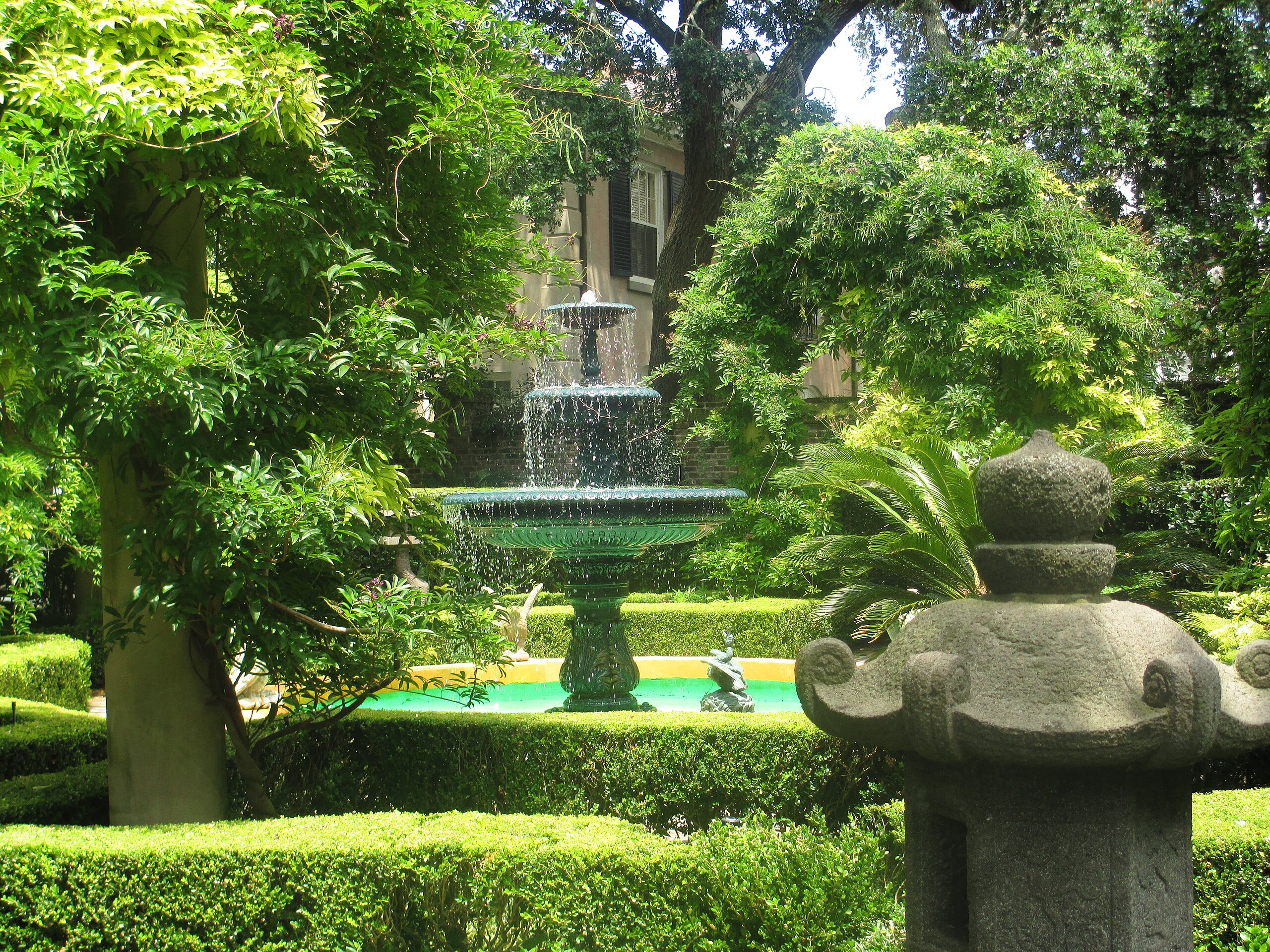
What then are the principal elements that might comprise a “classical” garden in Charleston, such as the Hanahan-South Battery site? As detailed by Cothran and other sources, they are often compact; enclosed (and thus private); closely linked to the owner’s house; constructed in “rooms;” formal in design; a mix of hardscape materials that include brick, stone, wrought iron, statuary, and fountains; horticulturally diverse; shady; and aromatic. Yet, the level of success that might result from the mix of such features and elements would nonetheless result from the combination of a garden designer’s talents and the vision of the property owner.
Several more years would pass before Society members as a group were to enjoy such gardens first hand, this coming during our tenth annual meeting held in March 1992. Organized under the leadership of the Dargans, the program provided opportunities for historic area walking tours, along with visits to private downtown gardens that demonstrated the classical town garden characteristics enumerated above. Providing detailed background information were presentations on Charleston gardens by Elise Pinckney; Louisa Cameron, author of The Private Gardens of Charleston; and Jim Cothran.
SGHS members in attendance quickly learned that a common denominator for any examination of these often-diminutive designed landscapes was the name of New York-born and Cornell-trained landscape architect Loutrel Winslow Briggs. A future post will look at Briggs and his work, as was discussed in detail by Lowcountry gardens authority Karen Padgett Prewitt and visited by Society members during the Charleston-based 2016 annual meeting. Of course, any Gardens page discussion of the Holy City must also bring to mind Patty McGee, 2023 posthumous winner of the William Lanier Hunt Award, gardener extraordinaire, and dedicated SGHS board member. Her memory, that of her husband Peter, and their garden in Charleston’s Ansonborough neighborhood will long bring a smile to the face of the many who called them friends.
*******************************************************************
*Duell would go on to be a presenter featured during 1991 RSGL program. He has been applauded widely for his Middleton Place work spanning nearly a half-century.
**For discussion of the project, see: https://southerngardenhistory.org/wp-content/uploads/Magnolia_Winter_1989.pdf#page=4
***For a review by former board member Susan Hitchcock, see:
https://southerngardenhistory.org/wp-content/uploads/2015/12/Magnolia_Spring2011.pdf#page=9
Leave a Reply