
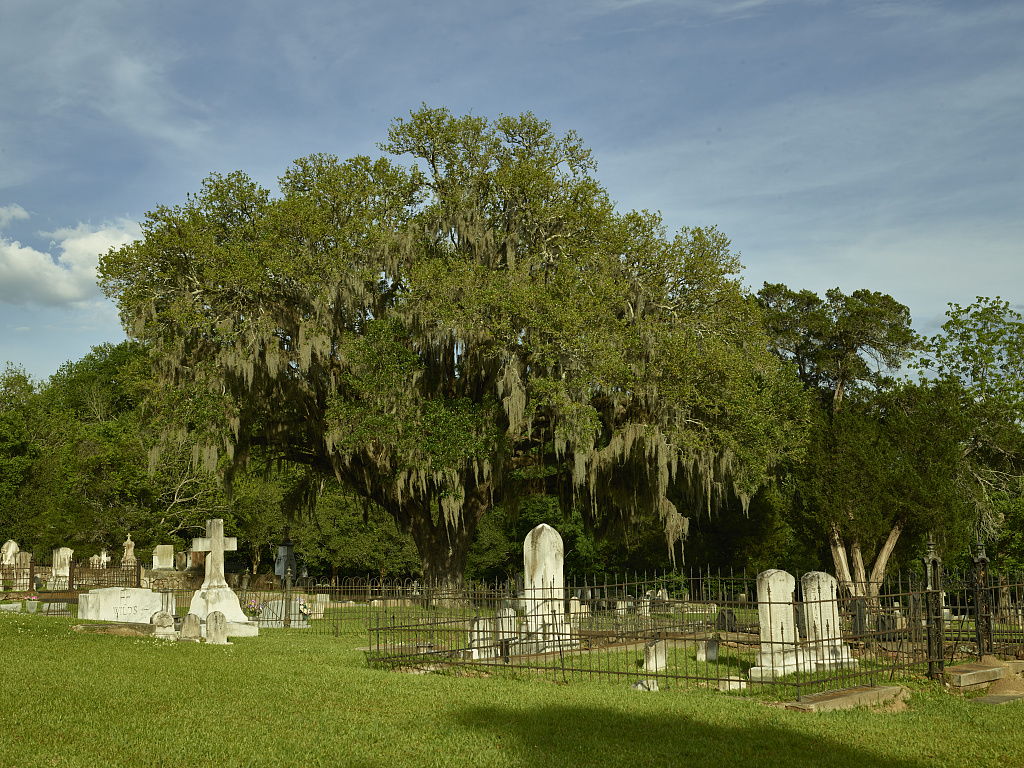
Credit: Highsmith (Carol M.) Archive, Library of Congress Prints and Photographs Division, Washington, D. C.
The Natchez Landscapes post of October 28, 2025, recalled annual meetings held in this famous city on the river, the first in 1984 and the second in 2002. The focus of that post was two especially significant landscapes, Longwood and Rosalie, with a promise of a future look at other important Natchez sites.
One such standout additional locale is the National Register-listed Natchez City Cemetery.* Though a visit there was not officially scheduled in 1984, many Society members surely enjoyed walk-abouts on their own. One cannot imagine famed rosarian and 1984 meeting speaker Cleo Barnwell along with speaker and SGHS co-founder Bill Hunt not exploring this venerable last resting place to see just what might be blooming. The City Cemetery, however, went on to be a scheduled Friday tour site in 2002. Speakers Teri Tillman and Bee Byrnes prepared us well through their talks “Plantings in the Historic City Cemetery” and “Bushes, Bones and Bios: ‘Plantings’ in the Historic City Cemetery.”
This famed cemetery dates to 1822 and is set on approximately one-hundred rolling acres east of the Mississippi bluffs and north of town. It precedes by nine years the 1831 opening of Massachusetts’ Mount Auburn Cemetery, that event being generally accepted as the beginning of America’s rural cemetery movement.** Being earlier, certain features found in Natchez do vary from Mount Auburn’s hallmark characteristics. Thus, for example, its rectilinear plan exhibits a dramatic contrast to the picturesquely curving roads and paths so notable in the layout of Mount Auburn’s grounds. In other ways, however, Natchez’s cemetery shared a number of central characteristics with rural cemeteries that were being developed across the nation, including such Southern burying grounds as Macon’s Rose Hill, Savannah’s Bonaventure, and Richmond’s Hollywood.
Set outside of Natchez proper, the new cemetery would thus join those in Massachusetts, Georgia, Virginia, and elsewhere and assume the characteristics of a public park where town citizens could not only mourn deceased family members and friends but also enjoy a leisurely stroll, encounter neighbors and have quiet chats, or perhaps enjoy a peaceful picnic. That enjoyment was enhanced by an expanding collection of handsomely crafted monuments and fine examples of wrought iron enclosures, along with plantings that offered not only comforting shade but also pleased the senses in the manner that only trees, shrubs, and flowering plants can offer.
Live oaks, of course, were crucial, but the City Cemetery also allowed Natchez citizens to express their sentiments by planting roses in remembrance of the dearly departed. In this they were aided in the 1840s and 1850s by the proximity of Natchez to Thomas Affleck’s Southern Nurseries in nearby Washington, Mississippi. The options were many, and for a look at Affleck’s personal thoughts on roses for the South the reader is directed to Pam Puryear’s “The Roses of Thomas Affleck” in the Summer 1991 issue of Magnolia.*** One might also long for the proverbial time machine to return to 1984 and hear once more Cleo Barnwell’s annual meeting talk “Old Roses Grown in Southern Gardens.”
While the Natchez City Cemetery has therefore gained an important place in our recollections of two Society annual meetings, it is not the only such landscape of major significance in the area. Immediately north of the City Cemetery is the eight-acre Natchez National Cemetery which was created just after the Civil War to serve as a permanent burial site for Union service members who died in the area during the conflict. Here the uniformity of the markers and regularity of their placement contrast sharply with the highly varied shapes, sizes, and positioning of those at the City Cemetery. Yet, that simple military precision and orderliness offers visitors a sense of solemnity and reverence that only such a landscape design and installation can induce.
*************************************************************
*https://npgallery.nps.gov/NRHP/GetAsset/NRHP/80002192_text
**James Cothran and Erica Danylchak’s 2018 book Grave Landscapes provides a highly recommended discussion of rural cemeteries and has been reviewed in the Spring 2026 issue of Magnolia. See: https://southerngardenhistory.org/wp-content/uploads/Magnolia.2026.XXXVII.4-1.pdf
***https://southerngardenhistory.org/wp-content/uploads/1991-Summer-Vol.-VIII-No.-1.pdf#page=7
Leave a Reply