
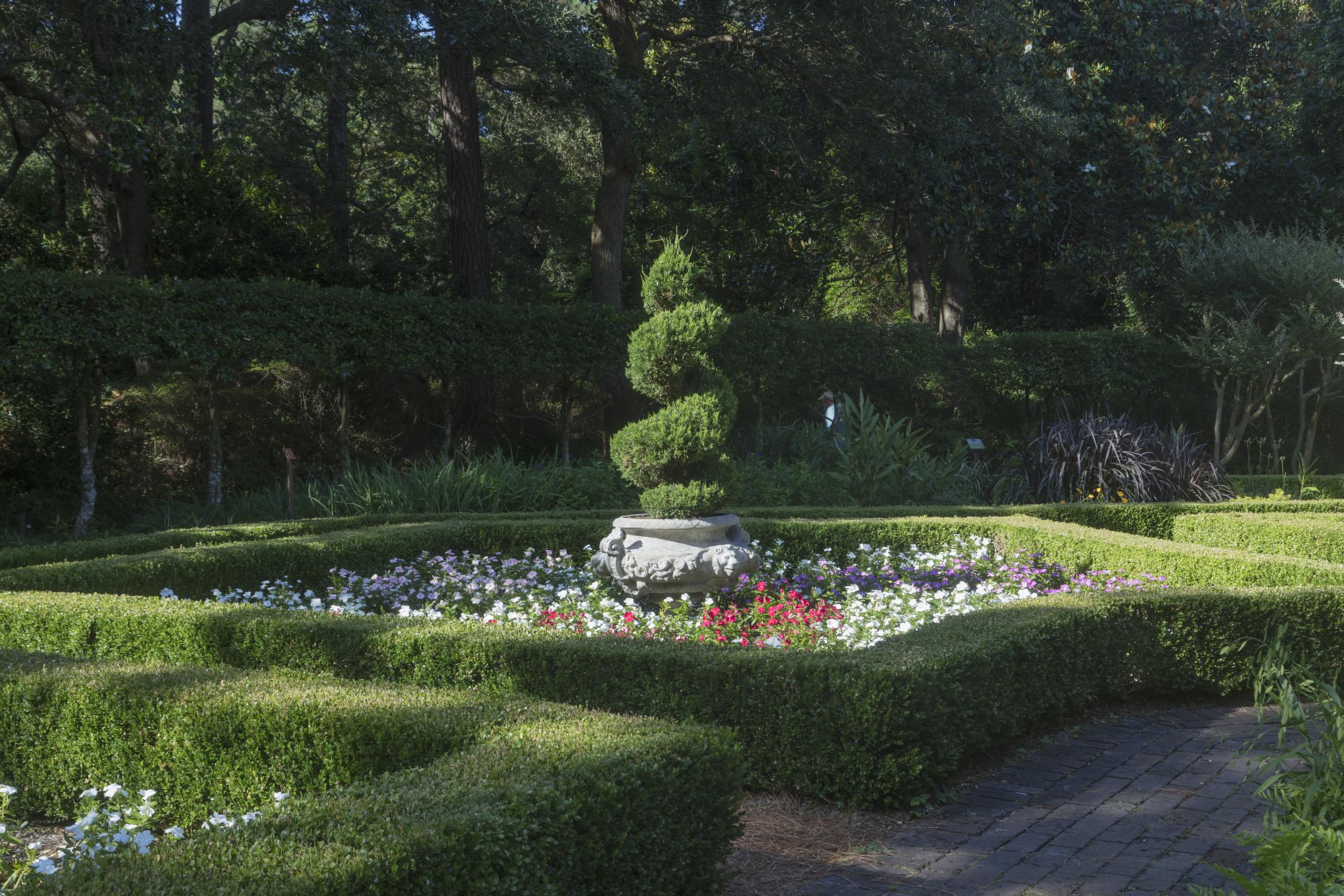
In his Summer 2007 Magnolia article “Beyond Boxwood and the Herb Garden” Davyd Foard Hood observed that Manteo’s Elizabethan Gardens joins several other twentieth-century Southern designed landscapes in rising “above the region to national if not also international acclaim.”* To date, this Roanoke Island location, set just west of North Carolina’s well-known Outer Banks, has not been on a scheduled SGHS tour. As the Society continues to thrive, however, such a visit always remains possible, and the Elizabethan Gardens (TEG) are thus more than worthy of a Gardens examination.
Of course, many members, including this writer, have come to know the Elizabethan Gardens while visiting the nearby Nags Head’s beaches or Kitty Hawk’s Wright Brothers Memorial. (Some may have visited during the period when SGHS Past-President Carleton Wood was overseeing TEG operations.) All readers, however, will surely know that the rationale behind creating “Elizabethan” gardens on Roanoke Island derives from this being the setting of the first English colony in the “New World,” it having been established first in 1585 and then resettled in 1587, all happening during the reign of the “Faerie Queen,” Elizabeth I.
The opening of the Elizabethan Gardens dates to 1960, its location being adjacent to the Fort Raleigh National Historic Site (dating to 1941) and near the Waterside Theater, where Paul Green’s play The Lost Colony has been performed since 1937. Thus, the ten-and-one-half acre property is relatively a new-comer to the complex, though to recall Davyd Hood’s observation their widespread “acclaim” has led the gardens to become a major draw for Roanoke Island visitors.
The Elizabethan Gardens’ origins date to the years just after World War II and in part reflect the good will that continued to be shared between Great Britain and the United States. As noted on the property’s website, the concept arose from a 1950 tour of the Fort Raleigh site by a small group of prominent American and British visitors who suggested to the Garden Club of North Carolina (CGNC) a garden project complementing Fort Raleigh. Wasting no time, CGNC accepted the proposal in 1951, with work at the selected location beginning in 1953 under the direction of the Long Island firm Innocenti & Webel.
Richard Webel ** took the project lead, the Harvard-trained landscape architect also playing a key role in acquiring Italian Renaissance statuary, a fountain and pool, plus other hardscape elements donated from Greenwood, John Hay Whitney’s Georgia estate. The gardens visited today display components drawn from a Tudor-era vocabulary joined to a diverse horticultural display reflecting a modern floral array keyed to seasonal color and a focus on specific plants, such as camellias and hydrangeas. Thus, as can be seen in the map linked below,*** the overall site encompasses a grouping of garden rooms separated by hedge, fence, and brick barriers. Some of these (e.g. the Sunken Garden) are then sub-divided into parterres featuring often fanciful clipped yaupon holly configurations enclosing small trees and/or ornamental plants.
The Elizabethan Gardens are also well known for sculptural work, and most especially the nineteenth-century statue representing Virginia Dare, daughter of colonist John White and acclaimed as the first English child born on this side of the Atlantic. Crafted in Rome by the Massachusetts-born artist Marie Louise Lander, the piece has its own fascinating history (including several years in the sea off the coast of Spain) easily discoverable by online sleuthing. Centrally featured as well is the larger-than-life John Har bronze representation of Elizabeth I, which was installed in 2004.
The Elizabethan Gardens’ website notes that Richard Webel’s design intention was “to create a garden Elizabethan in spirit and style but adapted to the present.” Each visitor must decide the degree to which that goal has been reached. This writer, however, can report on the sense of peace and reflection offered by the distinct garden spaces in strolling the paths and pondering the passage of over four centuries since the sixteenth-century days of Gloriana.
****************************************************************
*https://southerngardenhistory.org/wp-content/uploads/2015/12/Magnolia_Summer_2007.pdf
**For more on Richard Webel, see: https://www.tclf.org/pioneer/richard-webel
Leave a Reply