
Credit: Wikimedia Commons. Creative Commons Attribution-Share Alike 2.0 Generic. Author: Preservation Maryland.
London, Ontario, recently popped into the conversation while this writer was enjoying coffee with a Canadian friend. That, in turn, was a reminder that relatively few U. S. cities are named for the British capital, which then brought to mind our 2007 Society optional tour of London Town in Anne Arundel County, Maryland. That visit happened during our second Annapolis annual meeting. Some readers, however, might also remember an earlier London Town tour on April 28, 1985, during the Society’s third annual meeting and the first Annapolis gathering. Those who recall the meeting will also know that it was organized under the leadership of the redoubtable St. Clair Wright, a charter SGHS member and a member of our first board of directors.
London Town is set prominently on the South River, south of Annapolis and northwest of the Chesapeake Bay, operating as a twenty-three-acre educational and recreational site open to the public under the name Historic London Town & Gardens. After establishment as a seaport in 1683, it served the public back then too, but as an entrepôt, cross roads village, and ferry destination of significant importance to the colonial Maryland economy. At that moment, of course, tobacco had a significance dramatically out of proportion to its importance to the state’s economy today, even replacing hard currency as a medium of exchange. Tobacco marketing, in turn, largely shaped the face of colonial London Town.
During our 2007 SGHS visit the principal surviving reminder of the eighteenth-century London Town cultural landscape was the impressive two-and-one-half-story William Brown house. Built in 1758-1764 of brick laid in the rarely encountered and expensive header bond pattern, the knoll-top structure rivaled some to the best homes in the Chesapeake region. Conceived by Brown to serve as a tavern, it was acquired by the county early in the nineteenth century for use as an almshouse, continuing to serve the needs of impoverished county residents until the mid-1960s.
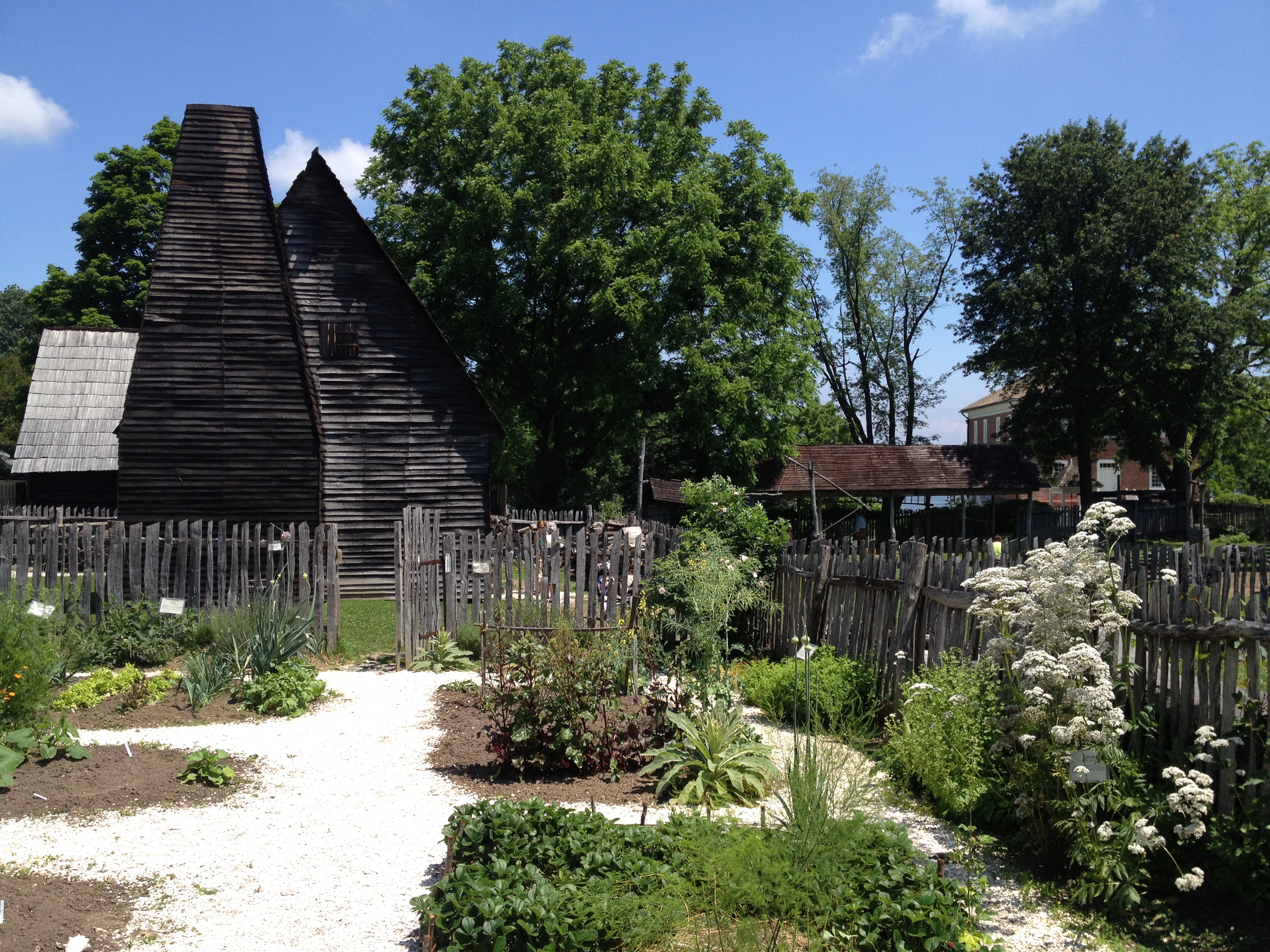
As brick structures were actually uncommon, however, imagining the colonial-period community requires that visitors recall the many wood-frame structures that long ago populated some of the approximately one-hundred London Town lots. Some, such as tobacco warehouses, were substantial indeed but many were smaller dwellings for enslaved or indentured laborers, workshops for artisans, or mercantile structures. Most of these consisted of one or two rooms, with fenced-in kitchen gardens and fowl yards providing much of the sustenance for the population. Archaeological investigation has helped provide evidence to create this mental picture, a visitor’s understanding of the early landscape being further enhanced by newly-constructed buildings that replicate period floor plans and earthfast building techniques.*
The “Gardens” component of the site’s modern name, however, represents a major departure from London Town’s appearance during its colonial moments. As evident by the plural form of garden, apart from the immediate Brown House landscape, the grounds feature several distinct designed spaces exhibiting a wide variety of plants. Particularly memorable are the paths that curve through the woodlands covering eight acres of the site. Within that space subdivided areas are devoted to the cultivation of more than forty types of magnolias; camellia varieties that bloom across the winter months; an azalea glade with groupings of both deciduous and evergreen plants; and a winter garden with a focus on mountain laurel and other evergreens. The Cook and Hall Memorial Gardens are set on additional acreage to offer formal ornamental displays featuring flowering shrubs, roses, annuals, and perennials. Briefly stated, the gardens here provide a year-round draw.**
Along with London Town, Society members recall the 2007 Sunday tours for a visit to Tulip Hill (named for its tulip poplars), being notable for its Palladian five-part construction and falling gardens; time spent at St. James Church, grave site of the famed garden writer Elizabeth Lawrence; and the exploration of other sites of interest.*** Most memorable of all, however, are the organizational skills of the annual meeting chair and long-time SGHS board member and secretary, Molly Ridout, and the work of a committee that included her brother, the late Orlando Ridout, one of the most talented architectural historians of our time.
************************************************************
*Also termed post-in-ground buildings, earthfast structures were common during the early days of European settlement in the Chesapeake region. Instead of being supported by a stone or brick foundation, they relied on vertical corner posts and other vertical timbers that were set directly in pre-dug holes in the ground. The horizontal sills were then attached to these upright posts and the remainder of the building was completed around this framework.
**For further details, see: https://www.historiclondontown.org/gardens
***Several photos taken during the Sunday tour are included in Staci Catron’s annual meeting review: https://southerngardenhistory.org/wp-content/uploads/2015/12/Magnolia_Summer_2007.pdf#page=8

Leave a Reply