
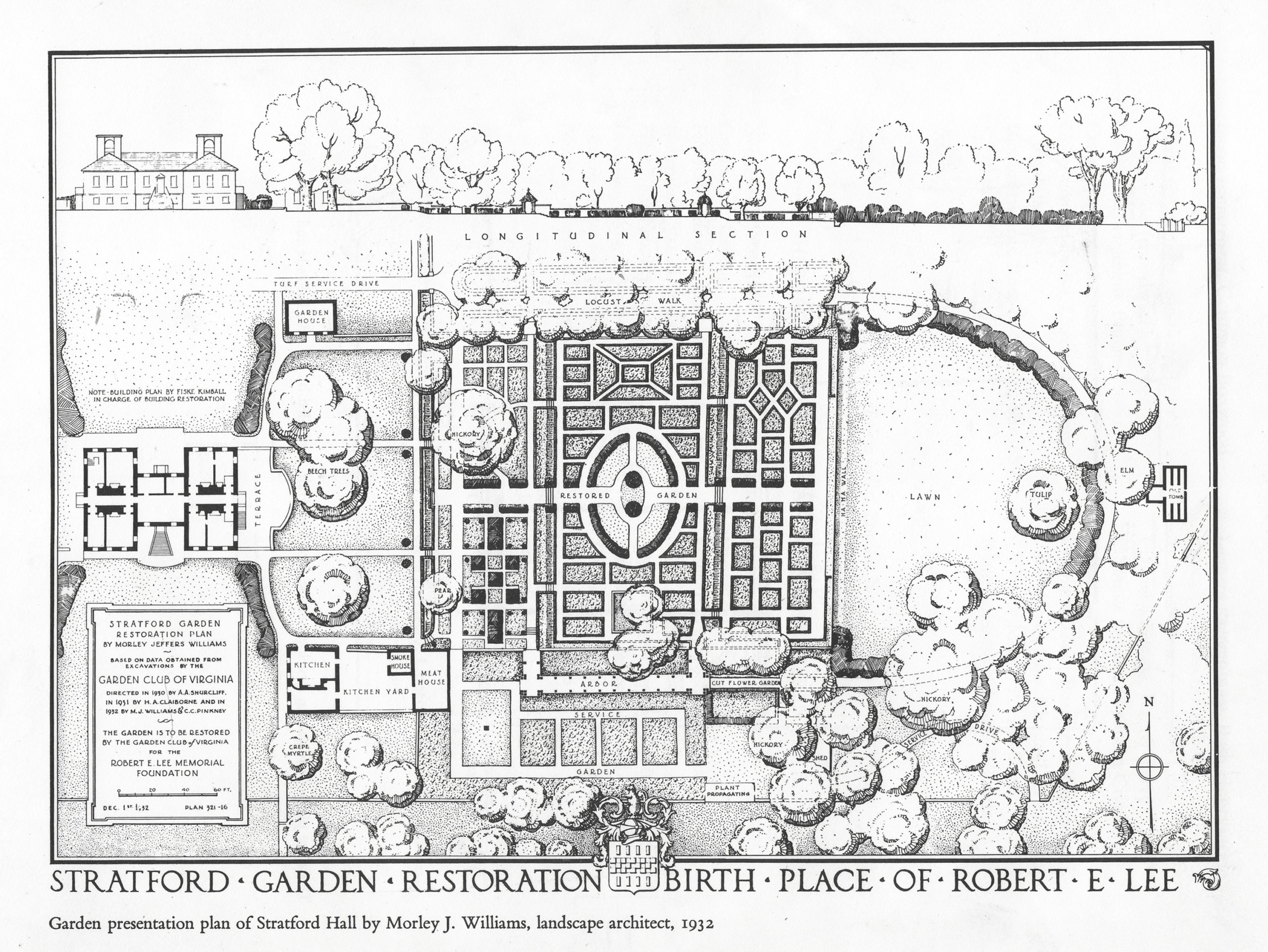
Credit: Garden Club of Virginia
Readers of this page and our SGHS publication Magnolia have encountered landscape architect Morley Jeffers Williams (MJW) several times in essays linking him to gardens visited by the Society. This writer had an additional on-the-scene opportunity to study Williams’ work through his employment at Virginia’s Stratford Hall.
Such readings and visits (and annual meeting lectures) make abundantly clear that no landscape professional is more strongly linked to Colonial Revival garden installations than Morley Williams. For the Ontario-born Williams, however, it might have been otherwise, since his early career in Canada seemed pointed more towards a focus on engineering and agriculture.* A paradigm shift appears to have begun, however, when first he took a horticulture degree in his native country and then journeyed to Harvard to study landscape design and later to join the faculty. Yet, the die appears to have been truly cast in the early 1930s when Williams received Clark Fund support to examine plantation landscapes in Maryland and Virginia.
The Virginia sites he studied and which to varying degrees felt his lasting impact included Gunston Hall, Monticello, Mount Vernon, and, as mentioned, Stratford Hall. Here, and at his subsequent work in North Carolina, Williams’ projects involved underpinning topographical study with his early use of archaeology to aid in developing the fullest picture possible of the landscapes in question. Still of great importance to landscape investigations, it was a “fledgling field” for Williams, as has been noted by North Carolina archeologist Thomas Beaman, a close student of MJW’s career.**
Any examination of Williams’ work underscores the peripatetic nature of his early years in the South, not surprising given the requirements of his Clark Fund grant. According to the Beaman article cited below, his first use of archaeology apparently occurred during a 1931 survey of Mount Vernon. As discussed in the Gardens post of December 21, 2024, Williams was soon at Stratford Hall, his work following up on previous investigations by Harvard colleague Arthur Shurcliff and aided by Harvard student Charles C. Pinckney. Site digs overseen first by Shurcliff and then by Pinckney were highly visible components of the project which led MJW to have plans ready by 1932 and to have a recreated East Garden (underwritten by the Garden Club of Virginia) largely in place by 1934.
At times between 1932 and 1934 MJW also found himself at Monticello, this again involving the early application of landscape archaeology. While there, Williams became involved with one of the great bits of garden lore of the period. Indeed, as this post was being written Monticello curator of plants and Magnolia editor Peggy Cornett shared the story now included in her new University of Virginia Press book Thomas Jefferson’s Flowers. Here Cornett recalls that Williams’ task included finding and documenting Jefferson’s famous Monticello Mountain roundabout roads. As well, “he was able to locate the walking path and several planting beds on the West Lawn.” Addressing the “garden lore” part directly, Cornett noted in an email message that indeed “it was Williams who first noted the winding walk paths on the West Front by shining his car’s headlights across the lawn,” a fact recorded in the diary of Garden Club of Virginia project director Mrs. Hazelhurst Perkins. Jefferson’s Flowers records that subsequently, Perkins confirmed and underscored MJW’s findings using her own vehicle’s lights.***
Williams would return to Massachusetts in 1934 to assist with restoration efforts at the Old Burial Ground in Cambridge. Soon enough, however, he was again south of the Mason-Dixon Line, his energies now turning chiefly to Mount Vernon. A subsequent post will explore his work there, along with his involvement with North Carolina State University, his role in the recreation of the Tryon Palace landscape in New Bern, and his personal and professional partnership with architect Nathalia Ulman.
*****************************************************
*https://www.tclf.org/pioneer/morley-jeffers-williams
**See Thomas Beaman, “The Archaeology of Morley Jeffers Williams and the Historic Landscapes at Stratford Hall, Mount Vernon, and Tryon Palace,” North Carolina Historical Review, Vol. 79, No. 3 (July 2002), 347-372. Accessed via JSTOR.
***This piece of Monticello garden history is also recalled in https://southerngardenhistory.org/wp-content/uploads/Magnolia_Winter2010.pdf.pdf

Leave a Reply