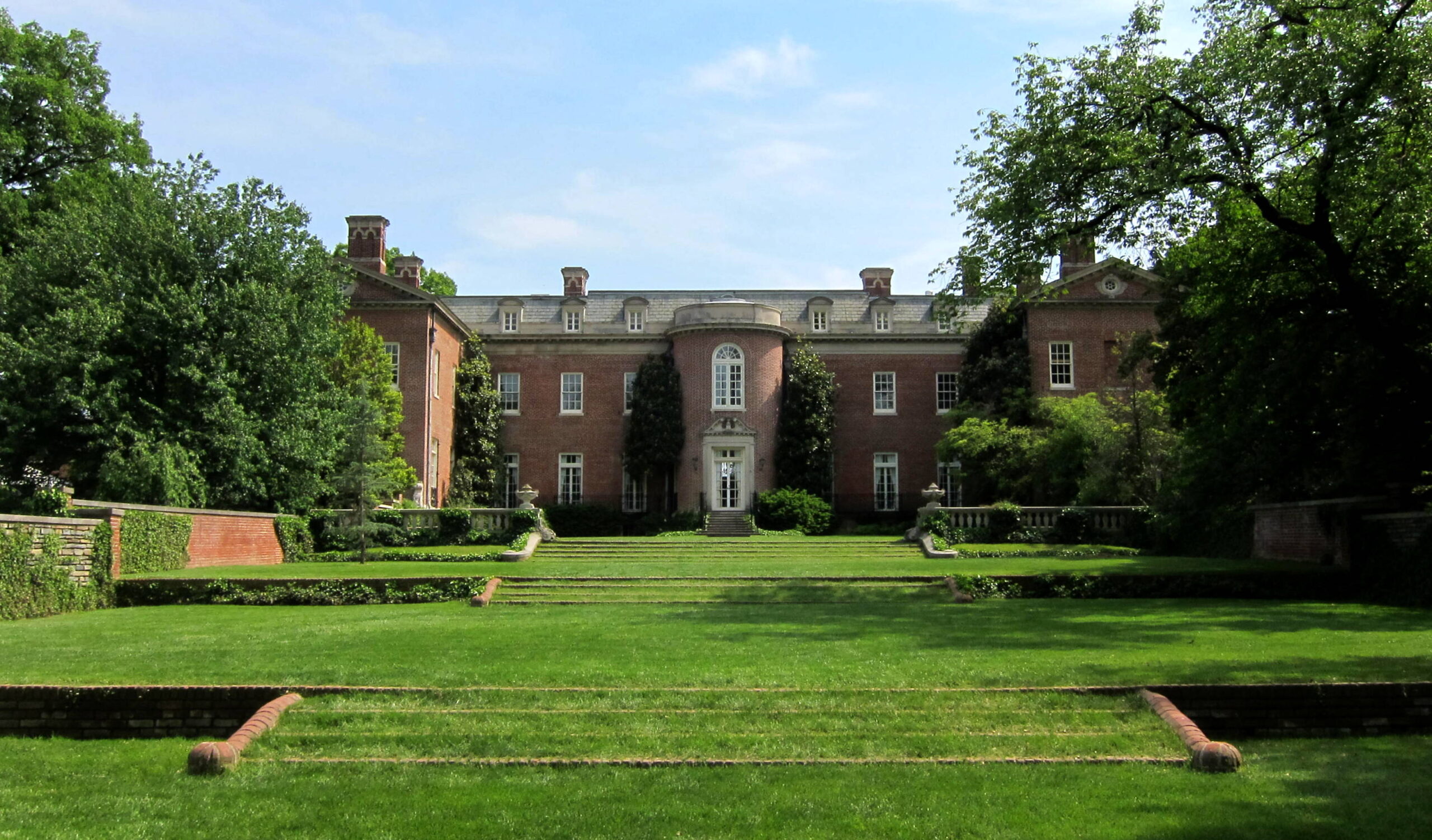
Credit: AgnosticPreachersKid photographer; Wikimedia Commons, Creative Commons Attribution-Share Alike 4.0 International.
This essay marks the fiftieth installation of a series of posts written for the SGHS website’s Gardens page, the first example having appeared on November 4, 2024. The focus then was Winston-Salem’s Reynolda, the gardens there reflecting the vision of owner Katharine Smith Reynolds and the talents of landscape architect Thomas Warren Sears. A year on, we close this first chapter of Gardens by looking at another stellar designed landscape, Dumbarton Oaks (DO). A garden of world renown, it chiefly owes its creation to not one woman, but to two, client Mildred Bliss and landscape architect Beatrix Farrand.
Twice Society members have had the opportunity to visit Dumbarton Oaks in conjunction with Mount Vernon-based annual meetings, the initial occasion coming in May 1990 and the second in May 2000. In both instances, the time allowed there was restricted since DO was but one part of a packed Sunday tour schedule. Given the garden’s size and the complexity of its design, there was clearly time enough only to gather in scattered, snap-shot like recollections. For this writer those memories include being introduced by charter SGHS member and biology professor David Rembert to a Franklinia alatamaha growing in a large pot and loaning film to Bill Welch on the North Vista, the dismayed rosarian and SGHS past president having discovered he had just used the last roll in his camera bag.
Over the years, however, many other factors would link the Southern Garden History Society with Dumbarton Oaks, central being the 1997 hiring of long-time SGHS treasurer Gail Griffin as DO’s first female director of gardens and grounds. Twenty-three years later she would write about the many points of connection between SGHS and DO in a website piece entitled “Of Common Mind,” material highly recommend to readers of this post.* Examples cited of SGHS-DO ties include the Dumbarton Oaks and Harvard Press 1985 publication of Magnolia editor Peggy Cornett’s Popular Annuals of North America, 1865-1914, while former board member and W. L. Hunt Award winner Suzanne Turner honed her professional knowledge through a fellowship in the DO Garden and Landscapes Studies program. Also included in Griffin’s essay is a link to a series of garden videos which help fill the memory gaps of those of us who visited in 1990 and 2000.
Magnolia, too, has offered Society members insightful articles and reviews on DO and the work of Beatrix Farrand there and at other locations. Among the standout essays was Judith B. Tankard’s Fall 2020 piece “Dumbarton Oaks Garden and Park: A Celebration.”** Here Tankard overviews the story of what she terms Farrand’s “undisputed masterpiece,” beginning with the 1920 purchase of the 1801 Georgetown knoll-top house by diplomat Robert Woods Bliss and his wife Mildred Barnes Bliss. Originally part of the Rock of Dumbarton grant to Scotsman Ninian Beall, the property also included an orangery and fifty-three acres of often steep, hill-side ground. The couple quickly turned to friend and a founding member of ASLA, Beatrix Farrand for guidance. ***
Through the 20s and into the next two decades Farrand addressed the challenges presented by difficult terrain while meeting the requirements of clients wanting direct project involvement but who were often overseas on diplomatic assignment. As Tankard writes and as period correspondence demonstrates a bond developed between the “landscape gardener” (a title Farrand preferred) and the client Mildred Bliss that led to garden results reflecting both the careful studies and long-honed talents of the former and the deep understandings and polished tastes of the latter.
Perhaps no site yet discussed on this web page better represents garden division by rooms than the final result of the Farrand-Bliss collaboration. (See the site plan linked below.)**** The vagaries of human nature will dictate preference for one space over another, or for grand sweep over intimate design. For example, many Society members will surely join the Blisses and Farrand in a deep appreciation of the Rose Garden, a spot packed with around nine-hundred plants carefully chosen for color pattern and frequently for repeat blooming characteristics. (It was a place so favored by the clients that it became the interment spot for their ashes.) Others find repose at the Lover’s Lane Pool and adjacent amphitheater, a section of the gardens revealing of Italian influences. Or, they are drawn to the Farrand-designed architectural elements and furnishings found across the Dumbarton Oaks landscape.
Readers may know that along with being students of fine landscape design Robert and Mildred Bliss were also advanced collectors of Byzantine art who went on in 1940 to donate their Georgetown home as a research center to Harvard, Robert’s alma mater. Today Dumbarton Oaks continues to support scholarly endeavors across a broad range of the humanities including an ongoing designed-landscape programs. Reflective of that commitment, as this post is being written DO is preparing to host a colloquium entitled “Gardens of the Roman Empire: A Born-Digital Publication,” a seemingly ideal marriage of two of the Bliss’s main areas of interest.
*****************************************************
*https://southerngardenhistory.org/gardens/of-common-mind/
** https://southerngardenhistory.org/wp-content/uploads/Magnolia-NL-Fall-20-FINAL.pdf#page=1
***For a biographical sketch of Farrand, see: https://www.tclf.org/pioneer/beatrix-farrand
**** https://www.doaks.org/visit/garden/explore
Recommended reading: Judith B. Tankard, Beatrix Farrand: Garden Artist, Landscape Architect.
Leave a Reply