
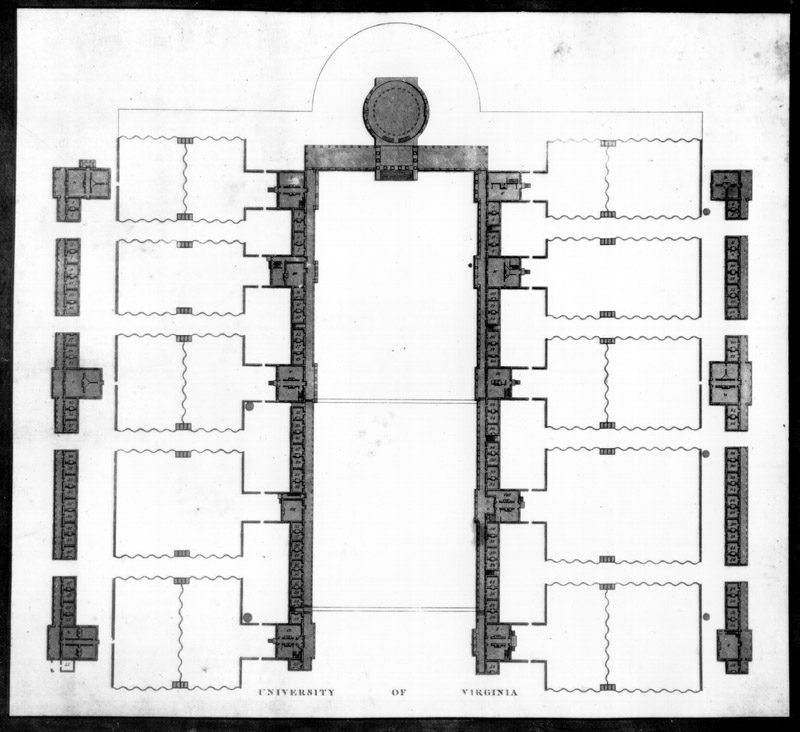
Credit: Wikimedia Commons, public domain, National Academy of Design. Authors, Thomas Jefferson and Peter Maverick.
Next year, 2027, will mark the fortieth anniversary of our Society’s tour of the oldest area of the University of Virginia (UVA) campus during our Charlottesville-based June 12-14, 1987, annual meeting. Of course, there was much more to the fifth SGHS yearly gathering, including deeply memorable after-hours moments at Monticello and presentations by an array of Jefferson landscape scholars.* As well, the Sunday tours offered opportunities to explore the highly significant Piedmont Virginia historic gardens and landscapes at Upper Bremo and James Madison’s Montpelier.
Yet, Jefferson’s UVA “Academical Village” possibly provided the highlight for those who might join a strong taste for Palladian/neoclassical architecture to a keen interest in landscape design and the study of post-Revolutionary developments in American higher education. To quote UVA’s Professor Louis Nelson, it is “one of the most important design complexes in early America.”** In 1987, it joined Monticello in becoming a UNESCO World Heritage Site.
Most readers will know the main features of the Jeffersonian campus, which dates to the period 1817-1826. Especially memorable is the central grassy terraced area known as the Lawn. Here stand the prominent Rotunda on the north and rows of alternating one-story room groupings and two-story (plus basement kitchens) pavilions running north and south on each side. Designs here reflect Jefferson’s enduring interest in Greek and Roman architectural concepts and, in particular, the influence of Italian Renaissance architect Andrea Palladio. Patterned after the Pantheon in Rome, the Rotunda primarily served as the university library, while the structures on each side offered student and professor housing and classroom spaces, all connected by covered walkways. A second set of structures to the east and west, known as the Range, provided additional spaces for housing and various day-to-day student and faculty needs. Walled-in interior areas, in turn, served a variety of chiefly practical purposes.
During the design-construction process Jefferson benefited not only from his own experiences at home and abroad, but also from the advice and efforts of many individuals, as outlined in the online Thomas Jefferson Encyclopedia and various other printed and Internet sources.*** Key input, for example, came from two the most prominent architects of the age, William Thornton and Benjamin Latrobe, the latter providing the idea for the Rotunda. As might be anticipated, much of the actual construction was executed by a large number of skilled and unskilled enslaved and free workers, with Jefferson himself often present to direct the work.
Exploring the topic through lectures at our host hotel and then on-site at UVA were Rudy Favretti and Will Rieley, landscape architects who in various ways would take center stage in matters of SGHS interest for many more years. In 1987, Favretti was serving as the Garden Club of Virginia’s (GCV) landscape architect, while after his 1998 retirement Rieley would assume that GCV position. In particular, Favretti and Rieley underscored the role played by GCV in restoring components of the Academical Village that over many decades had lost almost anything reminiscent of their early character.
That involvement had actually begun in the 1950s, with GCV calling on Colonial Williamsburg Foundation landscape architect Alden Hopkins for assistance. Over coming years Hopkins and later his successor Donald Parker in consultation with landscape architect Ralph Griswold would oversee the rejuvenation of all the ten spaces that lay behind the east and west pavilions. Analogous to the varying classical order pavilion facades, each of these areas assumed different design and flora configurations, often including Jefferson’s favorite plants. Key to the success of the project, in addition, was restoration of the famed one-brick-wide serpentine walls separating the individual spaces, though the height would be lowered from their original work yard-obscuring eight-foot level.
By the 1980s this extensive work overseen by Hopkins, Parker, and Griswold was showing its age, and thus GCV returned to address the problems that had developed. Now a team led by the Garden Club’s Favretti working with the Charlottesville-based Rieley replaced or repaired various hardscape features along with trees and ornamental plants as needed. In 2003, GCV supported yet more landscape improvements at UVA, Will Rieley joining forces with University landscape architect Mary Hughes with a focus on the Pavilion III gardens. (As in previous posts, the reader is directed to project details including site plans and extensive discussion of trees and other plants provided by Margaret Bemiss in Historic Virginia Gardens.)****
Of course, understanding a historic landscape involves both the ability to grasp what our senses reveal at a given moment and a strong element of imagination to help see how they might have appeared in earlier times. Today the practical components of the pavilion gardens might include their paths, social gathering places, and even shade and fruit trees. In the decades after their creation such trees were present and surely some ornamental flora. However, they were also enclosed places of labor. There enslaved hands, and their freed successors, washed student and faculty laundry, tended gardens, made meat and vegetables ready for cooking, and cut wood for the cellar kitchens and the upper level fireplaces, along the many other tasks required to make an Academical Village function on a day-to-day basis
*********************************************************
*For a discussion of the meeting by then Society president, Catherine Howett, see:
https://southerngardenhistory.org/wp-content/uploads/v-.4-no-.-2-Autumn1987.pdf#page=1
**For more from Nelson, see: https://www.youtube.com/watch?v=1hrHVLvDag8
***https://www.monticello.org/encyclopedia/jeffersons-plan-academical-village/ see also: https://encyclopediavirginia.org/entries/university-of-virginia-the-architecture-of-the/
**** Margaret Page Bemiss, Historic Virginia Gardens: Preservation Work of the Garden Club of Virginia, 1975-2007, “University of Virginia Pavilions III and VI.”

Leave a Reply