
Credit: https://en.wikipedia.org/wiki/en:Creative_Commons https://creativecommons.org/licenses/by-sa/3.0/deed.en Minipaula
During two Savannah annual meetings Society members have driven by/walked through the mid-city Colonial Park Cemetery. Beginning early in Savannah’s history as the burying ground for Christ Church Parish, this site continued to serve the town’s needs until the middle of the nineteenth century when overcrowding ruled out further interments. Savannah thus faced a situation being paralleled by other American municipalities, a phenomenon leading to what became termed the rural cemetery movement. As underscored by James Cothran and Erica Danylchak in their fine 2018 book Grave Landscapes: The Nineteenth-Century Rural Cemetery Movement, Mount Auburn Cemetery in Massachusetts led the way in 1831, setting the pattern for numerous suburban burial sites. Encompassing parts of Cambridge and Watertown, Mount Auburn was and is a naturalistic park-like elegiac landscape that contrasts dramatically to grave-packed locales such as Boston’s Granary Burying Ground.
Savannah’s answer to urban burial problems would be its own rural cemetery, Bonaventure Cemetery.* Surprisingly, Magnolia has given Bonaventure little attention, the principle reference appearing in a Winter 2002 piece on nineteenth-century South Carolina garden writer Mary Catherine Weir Rion.** As the article explains, it was her future husband James Henry Rion (m. 1851) who in 1850 received a commission to plan a cemetery on a seventy-acre segment of the six-hundred-acre Bonaventure Plantation, a property located on the Wilmington River three miles from Savannah. (Rion was then studying engineering at South Carolina College.) Four years earlier, Rion’s friend Peter Wiltburger had bought the land from U. S. Navy Commodore Joseph Tattnall III, that family having acquired the plantation prior to the American Revolution. Loyalist sympathies led to their loss of Bonaventure, though by 1801 not only was it back in family hands but Joseph Tattnall, Jr. would soon become governor of Georgia.
Burials began immediately after initial site work was completed, though these new arrivals would keep company with members of the Tattnall family, their earliest interment there dating to 1802. Ironically, Peter Wiltburger himself joined those who came to rest here soon after the 1850 opening, Wiltburger having died in 1853. Ownership then fell to his son, William Wiltburger, who in 1868 created the for-profit Evergreen Cemetery Company. It so functioned until being acquired by the City of Savannah in 1907, at which time it became both a public facility and was officially named Bonaventure instead of Evergreen in keeping with enduringly popular terminology.
Though widely defined as a rural cemetery as the term became used in the 1800s, Bonaventure does not mimic the more typical design of burial sites such as Mount Auburn or Richmond’s Hollywood Cemetery. (See Bonaventure map.***) Instead of incorporating the winding roads and paths typical of such well-known locations, Rion used preexisting plantation features to create a plan largely based on radiating straight lines, circles, semi-circles, and arcs.
Justifiably, the vegetation that complements Rion’s design figures high in the public imagination, especially the many live oaks that grace the property. Only a few years after its establishment as a cemetery, the famous traveler John Muir commented that “the most conspicuous glory of Bonaventure is its noble avenue of live-oaks.” Just as today, that “glory” was further enhanced by Spanish moss which Muir termed “Long Moss” (Tillandsia usneoides).****
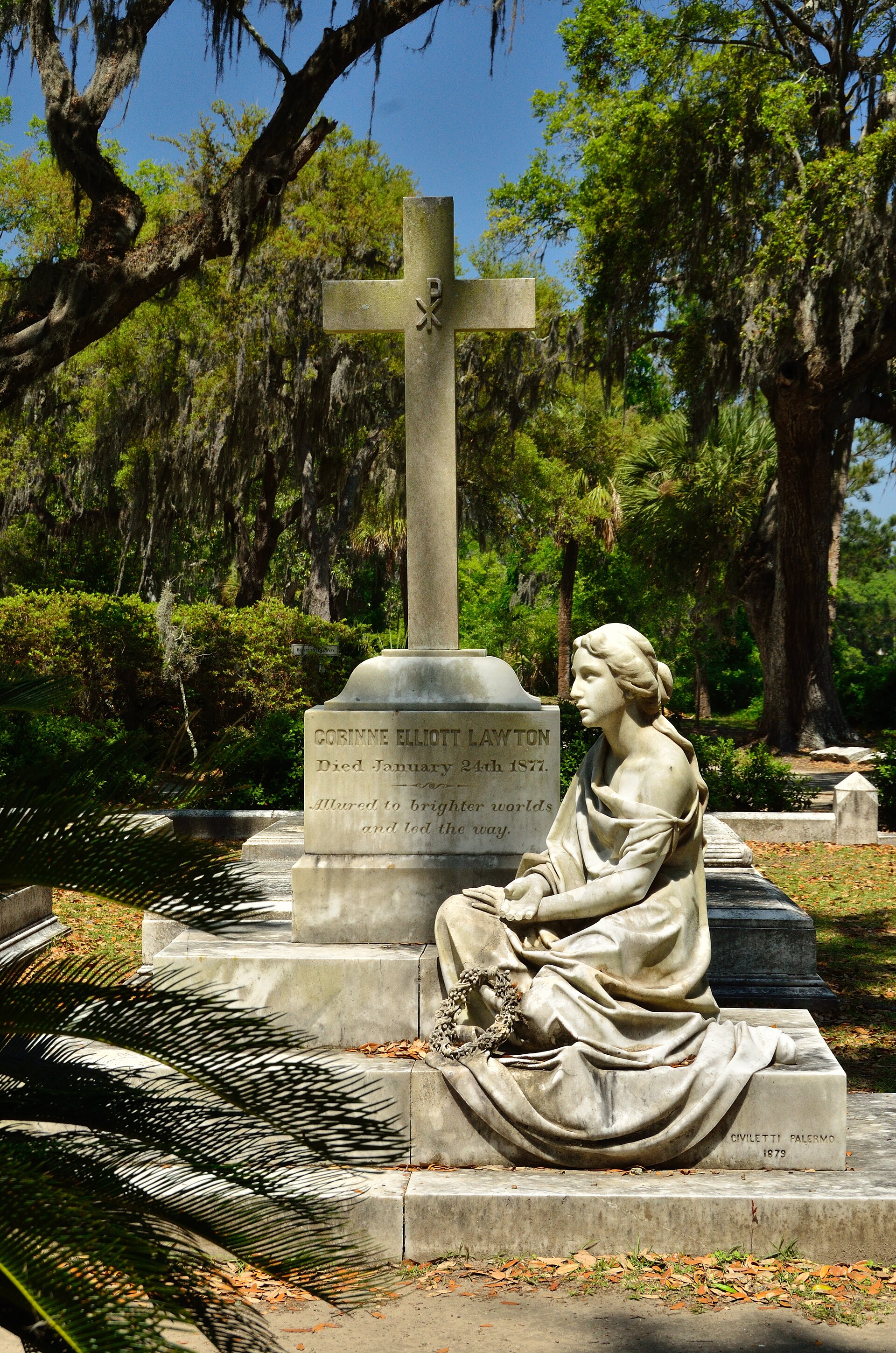
Bonaventure also stands out for its architectural features, monuments, and celebrity graves. The first category includes two separate entry gates, one displaying stars of David to distinguish a Jewish section dating to 1909. Here visitors encounter one of the cemetery’s most noteworthy buildings, a single-story hipped-roof Jewish mortuary chapel constructed of brick in 1917 and possibly designed by local synagogue member Hyman Witcover. Monuments run the gamut of styles reflecting their installation period, the tastes of families involved, and the skills of individual sculptors and stone carvers, some ornamenting graves relocated from Colonial Park Cemetery. In recent times, the 1994 cover of Midnight in the Garden of Good and Evil brought fame to Sylvia Shaw Judson’s 1936 bronze statue known as the “Bird Girl,” since removed from Bonaventure and on exhibit at the Telfair Academy.*****
As might be imagined, famous people of every stripe have found their way to Bonaventure, including governors, business leaders, and artists. The burial sites of children continue to sadden visitors as well, including that of six-year-old Gracie Watson (d. 1889), whose life-size statue numbers among the cemetery’s best-known spots. For this writer, however, the most compelling burial is that of composer, singer, and Oscar winner Johnny Mercer, whose songs were heard long ago on the family Victrola and whose soft Savannah voice was known via radio, film, and television to millions across the nation. Drawing from Mercer’s lyrics, a stone bench near his grave perpetually reminds us to “AC-CENT-TCHU-ATE THE POSITIVE.”******
*****************************************************************
*For further detail, see the National Register nomination: https://npgallery.nps.gov/GetAsset/9079e469-4e40-42d3-be72-57ab1d923071. See also: https://www.tclf.org/landscapes/bonaventure-cemetery
**https://southerngardenhistory.org/wp-content/uploads/2015/12/Magnolia_Winter_2002.pdf#page=10
***** https://en.wikipedia.org/wiki/Bird_Girl
****** To hear Johnny Mercer perform this song in 1944, visit: https://www.youtube.com/watch?v=DecrMG4K_nI
Leave a Reply