
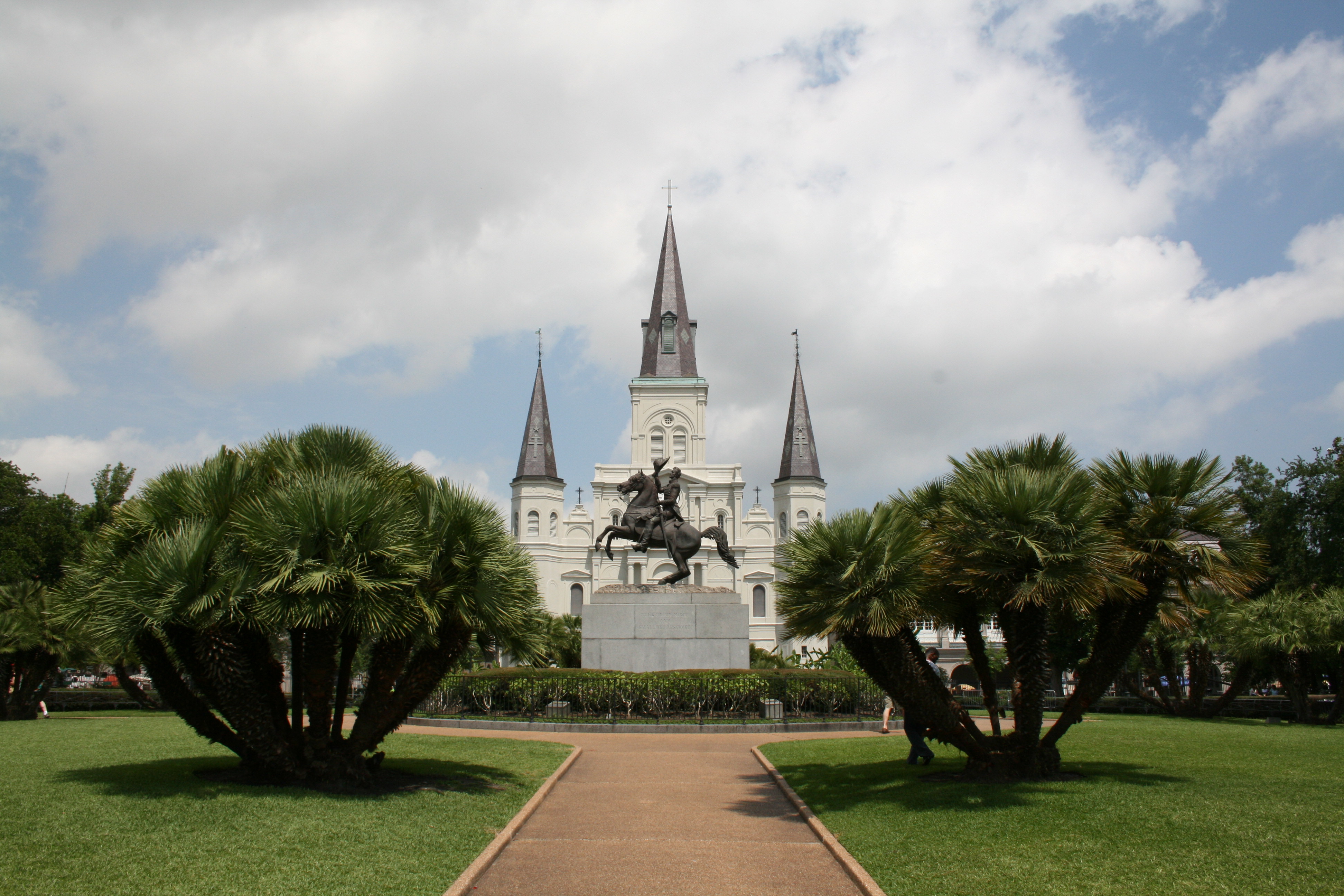
“Jackson Square in New Orleans visited by Frederick Law Olmsted in 1853 and the Southern Garden History Society in 2004.”
Credit: Wikimedia Commons, “Diego Delso, delso.photo, License CC BY-SA
The Gardens post of March 15, 2026, explored that segment of Olmsted’s 1853 visit to the South that included his travels down the Carolina and Georgia coast and then his train ride west from Savannah to Columbus. The landscapes the New York Times reporter described ranged from picturesque to vernacular-utilitarian, from avenues of stately live oaks draped with Spanish moss to large-scale plantation quarters for the enslaved and factories set along the Chattahoochee River.
Crossing from Columbus into Alabama, Olmsted found frontier conditions that reflected the recent removal of long-resident indigenous families. Though admitted to the Union in 1819, Alabama still offered roads that Olmsted recorded as “little better than open passages for strong vehicles through the woods.” The “larger proportion of the planters,” moreover, continued to dwell in log houses. Contrasting with a sylvan landscape being changed from forest to cotton fields were the Alabama towns described by the traveler as notable “for the neatness and tasteful character of many of the houses and gardens…” Included among those places was Montgomery, reported to be a “fine and promising young city” featuring “very pleasing suburbs.” In Olmsted fashion, however, he attributed the town’s “remarkably enterprising population” to the presence of a large number of “Northern and foreign-born business-men and mechanics.”* (Sadly, few in the Society today will recall our 1986 fourth annual meeting that was held in Montgomery or the efforts of early members Ed Givhan, Peggy Givhan, and George Stritikus that made the event especially memorable.)
From Montgomery Olmsted continued his explorations afloat, steaming down the sinuous Alabama River to Mobile and finding that the slow pace allowed time for excellent views of life on a Southern river. In what would later be termed “the azalea city” and the setting for two SGHS annual meetings, FLO found the commercial section distasteful but had praise for the remainder of the town, noting that most Mobile houses had enclosed plots planted with “trees and shrubs.” The finest trees, he said, were the magnolias and live oaks, while “the most valuable shrub is the Cherokee rose, which is much used for hedges and screens.” He noted “an abundance, also, of the Cape jessamine.”
As readers can imagine, a New Orleans visit was a must-do for the Times reporter. Thus, he followed a short stay in Mobile with a rapid steamship and rail trip to the Crescent City, arriving in mid-February 1853. While critical of his St. Charles Hotel lodging place (“stupendous, tasteless, ill-contrived and inconvenient”), FLO expressed delight in “the old Place d’Armes, now a public garden, bright with the orange and lemon trees, and roses and myrtles, and laurels, and jessamines of the south of France.” Now Jackson Square, the former Place d’Armes may be recalled by SGHS members attending the 2004 New Orleans annual meeting as much for its proximity to the Café du Monde’s beignets as for its circular walks, azaleas, sparkling ornamentals, and tropical plants.**
Walking about such designed urban grounds, however, did little to aid the Connecticut Yankee with his goal of reporting on the conditions of plantation slavery. Suspicious planters were clearly apprehensive about allowing access to a Northern correspondent. In coming days, however, Olmsted would visit several of the sites he longed to tour, the first being Richard Taylor’s 1,200-acre plantation named “Fashion” and set only twenty miles north of New Orleans.***
Here fronting his host’s “old Creole house” (one thinks of Parlange or Maison Chenal which Society members visited during the 1991 St. Francisville annual meeting) he found a “yard, planted formally with orange-trees and other evergreens.” To the rear were not only quarters for the enslaved members of the household but also “a kitchen, stable, carriage-house, smoke-house, etc.” Even farther back was a full acre devoted to vegetable growing and tended by an enslaved gardener who had added a variety of ornamental plants to provide additional color to the produce bounty. Despite his use of enslaved labor, Taylor impressed Olmsted as being “a man of more than usual precision of mind, energetic, and humane…” Readers attuned to Civil War history may recall that only eight years later Richard Taylor, though an opponent of secession, was a Confederate general. As well, he soon became homeless, Fashion plantation being looted and confiscated by Federal troops in early 1862.
Olmsted would visit several other Louisiana towns and plantations before endig his first Southern journey. Of further resonance for Society members will be his time in and around Natchitoches, which readers might easily explore online in A Journey in the Seaboard Slave States. (See the first asterisk below for the URL.) Those who attended our 2023 annual meeting, however, might wonder at Olmsted’s observation that “I was told that there was more morality, and immorality in Nachitoches (sic) than in almost any other place of its size in the United States.” Clearly Frederick Law Olmsted had much to ponder over, and write about, by the time he returned to his Staten Island farm on April 6. And yet, his travel experiences in the South had just begun.
******************************************************
*Some of these and other quoted lines are taken from The Papers of Frederick Law Olmsted, Vol. II, Slavery and the South, Beveridge, McLaughlin, and Schuyler editors. Other quoted material comes from Olmsted’s A Journey in the Seaboard Slave States, which can be found at:
https://docsouth.unc.edu/nc/olmsted/olmsted.html.
** https://www.tclf.org/landscapes/jackson-square
***The son of President Zachary Taylor, Richard Taylor was an 1845 graduate of Yale and a member of the school’s Skull and Bones Society. Olmsted had family and friends with Yale connections that provided the link he needed to find an open door at Fashion Plantation.

Leave a Reply