
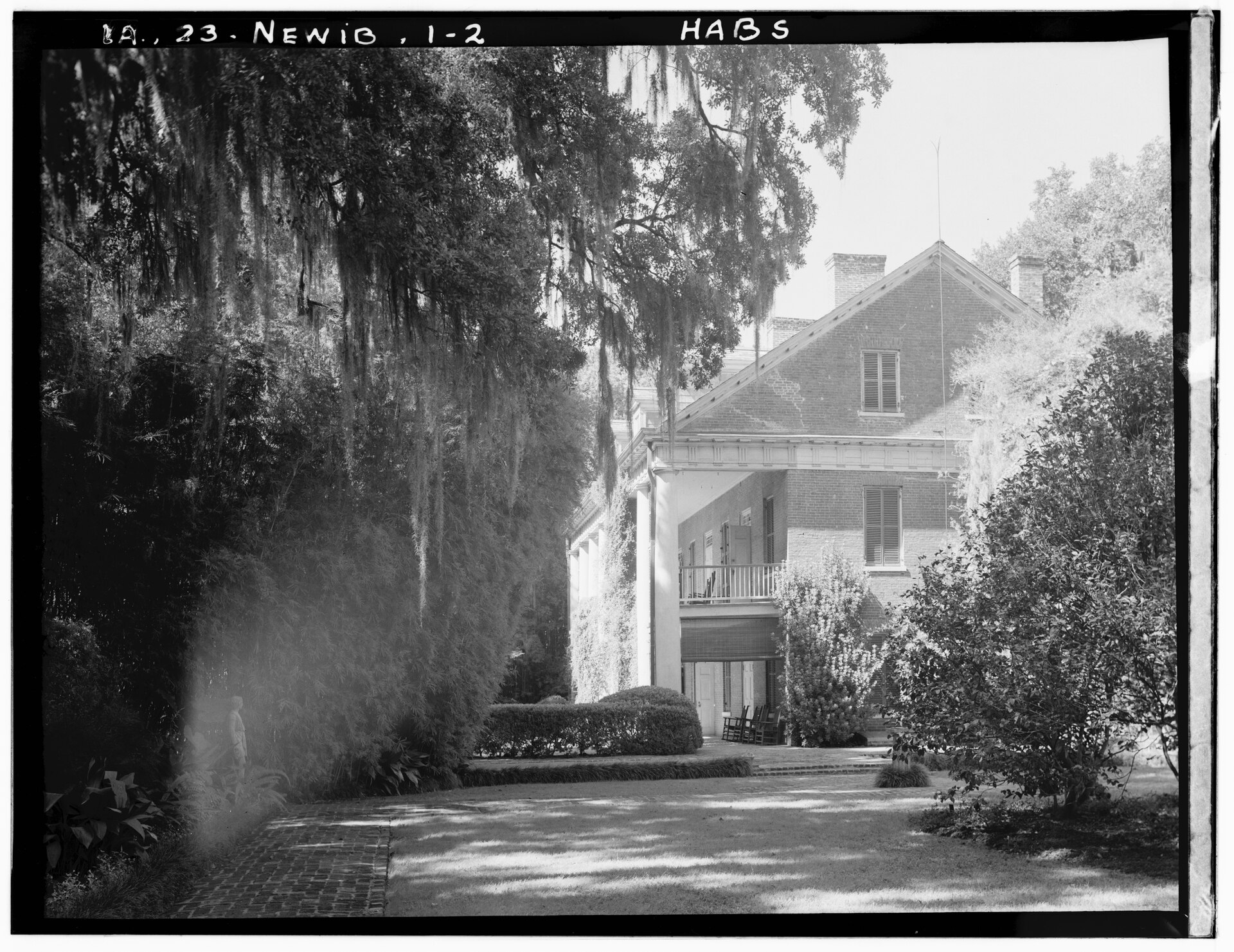
Credit: HABS, Library of Congress, Wikimedia Commons
Society members have toured gardens across a wide span of Louisiana, beginning at St. Francisville in 1991, then New Orleans in 2004, Baton Rouge in 2011, and most recently Natchitoches in 2023. Perhaps in the future we will go west of New Orleans to the Lafayette area and visit the topic of this post in New Iberia.
Shadows-on-the-Teche, a National Trust for Historic Preservation property and a National Historic Landmark, is high on the list of famous Louisiana homes and high on the banks of Bayou Teche. In preparation for a tour, members would likely “study up” and learn that the Shadows, as it is often termed, has multiple periods of significance. A bit of digging will also reveal the substantial research done on the Shadows by Suzanne Turner, a former SGHS board member and the 2019 winner of the William Lanier Hunt Award.
The initial significant era began during the early 1830s when David Weeks and his wife Mary Clara Conrad Weeks built a large brick home considered one of the South’s best examples of Greek Revival architecture. Sugarcane grown on multiple plantations by large numbers of enslaved workers provided the main financial underpinning. Dying in 1834, David Weeks saw little of the new place. Mary Weeks survived long thereafter, however, marrying lawyer John Moore in 1841 and continuing to manage the plantations throughout the antebellum years.
Now two acres, the early Shadows site included almost one-hundred-sixty acres abutting a larger Weeks family plantation. Vegetable gardens produced food for owners and enslaved alike, while the separate brick kitchen joined other service buildings vital to a busy working landscape. The core area, in turn, was at the center of a larger zone of cane production, all making for a great hub-bub of daily life. Yet, as captured by New Orleans-based painter Adrian Persac, the Shadows property was also visually pleasing, live oaks shading a curtilage enclosed by long expanses of white picket fences. In her 1997 book Louisiana Gardens, Suzanne Turner credits the gardening wisdom and skills of Mary Clara, along with several of her children, for much of the Shadows pre-Civil War appearance.* Family documents mention plant and seed orders, including items sent by husband John Moore when serving in the US Congress, along with roses and fruit trees ordered from the nursery of Thomas Affleck.**
Soon, however, Mary Clara and John Moore faced the disruptions and transformations caused by secession, war, and military occupation. Indeed, in 1863 the Shadows became a Union Army headquarters. A committed secessionist, John Moore left the area while Mary Clara lived briefly in the home’s upper floor until her death in December 1863. Buried at the Shadows, she was joined in 1867 by husband John, their graves thus becoming an integral part of the home grounds.
Over the reconstruction era and later years, her son William Weeks and his family made the Shadows their home, continuing to embrace Mary Clara’s gardening habits. Turner’s Louisiana Gardens references the especially keen interest of daughter Mary Lily (d. 1918), whose marriage to lawyer and planter Gilbert Hall (d. 1909) resulted in an only child, the New Orleans-reared artist William Weeks Hall. He, in turn, would be the driving force in determining the twentieth-century future of the Shadows, a place of childhood memories.
Hall honed his awareness of color and form through art training in America and abroad, making the Shadows his home and canvas beginning in the early 1920s. Hall also helped to develop a certain mystique about the Shadows, aided by his connections to the Hollywood and literary world. While saving aged camellias, live oaks, and family grave markers, Hall took down deteriorating nineteenth-century buildings and shifted to a romantic setting replete with the features needed to complement a reimagined landscape. Working with preservation architect Richard Koch who guided the overall Shadows restoration, he built a new summer house and used the bricks from former dependencies for a patio and walks.*** Statues of various subjects and forms became key elements in the garden, standing fixed amid a plant palette that might shift as Weeks Hall readjusted his vision. As noted in Louisiana Gardens, author Henry Miller recalled Hall’s philosophy in the succinct statement: “A garden is a show—why not make one enormous garden, one big changing show?”
Hall would grow increasingly introspective and self-isolated as he aged, retreating behind screenings of bamboo, but he retained a determination to see the Shadows preserved beyond his lifetime. That vision became realized when just prior to his 1958 death the National Trust agreed to assume ownership and management of Shadows-on-the-Teche. It only remains now for SGHS to schedule another annual meeting in Louisiana, and we will see the result first hand.
**********************************************************
*Suzanne Turner, text; A. J. Meek, photographs, The Gardens of Louisiana: Places of Work and Wonder, “New Orleans Botanical Garden,” 119-129.
**The Scottish-born nurseryman Thomas Affleck relocated from Washington, Mississippi, to Washington County, Texas, in ca. 1859. For examples of his offerings, see: https://southerngardenhistory.org/wp-content/uploads/2016/05/SouthernPlantLists.pdf, 222-224. See also: https://southerngardenhistory.org/wp-content/uploads/1991-Summer-Vol.-VIII-No.-1.pdf#page=5
***For an overview of Koch’s (pronounced “Coke”) life and impressive work history, see: https://www.kochandwilson.com/richard-koch-architect

Leave a Reply